


James Shepherd-Barron
Latest posts by James Shepherd-Barron (see all)
- HOT FROGS and the monetization of money - 3rd March 2021
- CoVid Lessons Un-Learned - 29th January 2021
- HOLE IN THE WALL (Book Extract) - 18th January 2021
The Cash Management Industry should work with the World Health Organisation and other stakeholders in international health to improve the public’s confidence in cash (physical currency) for a post-disaster, post-Covid world.
In the Summer of 2014, when the Ebola epidemic in West Africa was just beginning to accelerate, I was attacked outside a hospital in Sierra Leone by a mob who believed that banknotes had become a vector for the transmission of this dreadful viral disease. I was lucky to get away with my life.
Four years later, when I was helping deal with yet another Ebola outbreak, this time in the Democratic Republic of Congo, cash agents in Kivu were brutally attacked and their booths burned to the ground for the same reason.
This is not a matter of superstition; it is born of a perfectly rational fear that cash might be contaminated. Around the world, the advent of Covid-19 has seen societies in so-called ‘developed’ countries beginning to shun cash too … thankfully with less violence.
Misleading comments by the World Health Organisation and others at the outset of the Covid-19 crisis[1] hasn’t helped, prompting the public to lose confidence in cash to such an extent that the cash management industry appears to think that the future of cash as a public good will be in peril if the infrastructure needed to sustain a minimum level of cash degrades much further[2].
This presents public and private sector stakeholders working on humanitarian cash and voucher assistance with a significant challenge about how best to respond. On the one hand, it’s not possible to say that cash is totally without risk, yet on the other the vast majority of low-and-middle-income-countries in which they operate lack the sophisticated infrastructure required for end-to-end digital payments, leaving their citizens with little option but to use cash. Given that nearly half (48%) of the world’s adult population either did not or could not make an electronic payment in the last year for which figures are available[3], this is no small matter.
In light of this humanitarian dilemma, the cash management industry could do more to reassure all those humanitarian agencies around the world struggling to support host governments with their Covid-19 social protection responses:
First, it would be helpful if the cash management industry produced a single definitive statement based on a comprehensive meta-analysis of existing research to establish reliable baseline statistics on the threat of infection posed by physical currency versus alternative forms of payment. This can then be used by WHO to inform any future technical guidance on the matter. At the moment, only two studies provide such analysis, one by the Bank of International Settlements[4], the other by Currency News[5].
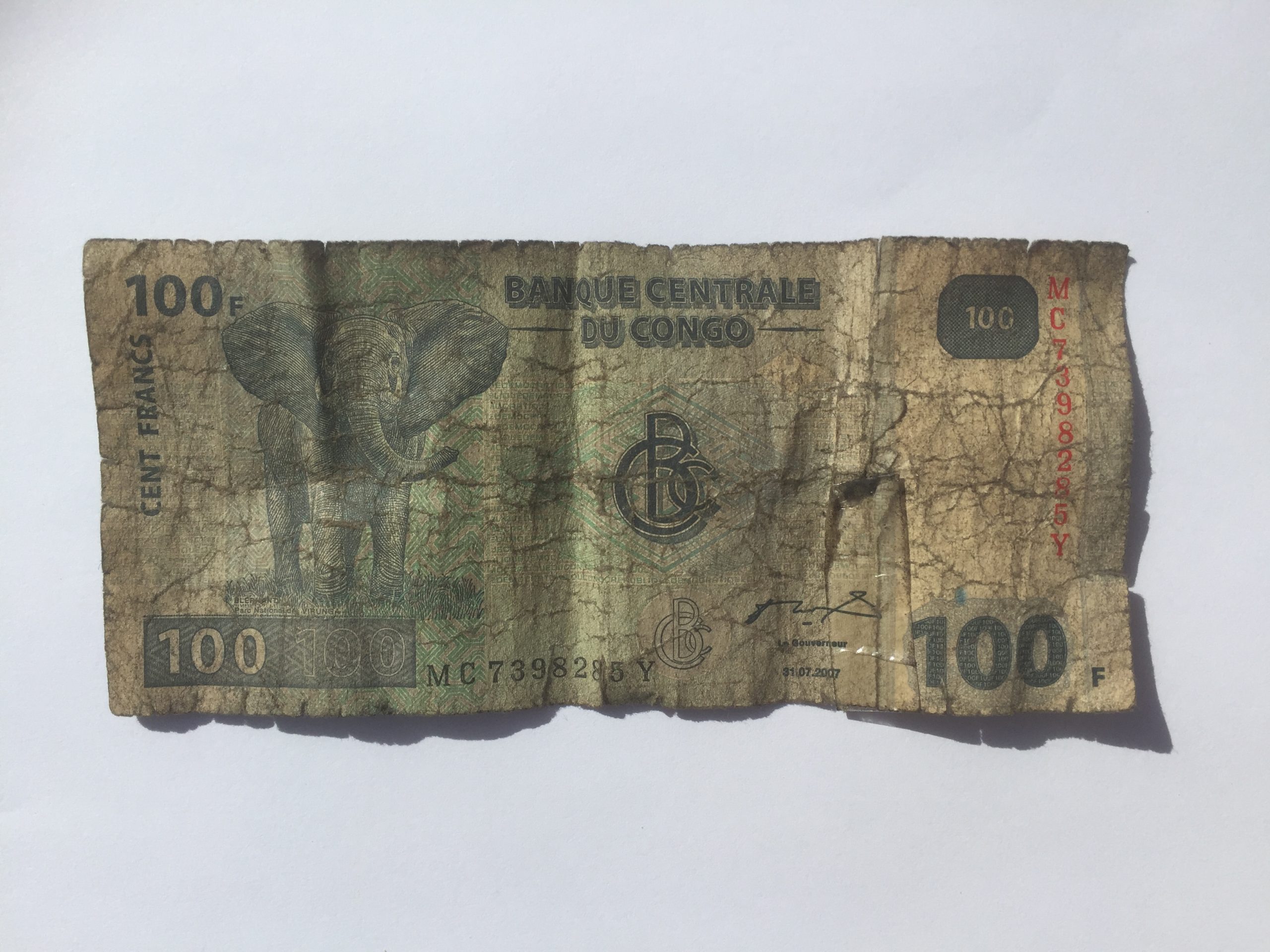
Second — and no less important — original research should be commissioned on the transmissibility of Covid-19 via banknotes already circulating in low-income societies (not just surfaces in the laboratory). The quality of most of these, like the one from DRC pictured above, is currently well below that which would be acceptable in high-income countries.
Third, manufacturers – substrate makers, ink companies and security printers – ATM deployers, and cash handling companies should describe in as much detail as possible the technologies and practices involved in banknote production and distribution. Many banknotes these days are treated with anti-microbial agents and surfactant varnishes which inhibit the viability and transmission of bacteria, viruses and fungal spores[6].
Fourth, as Currency News outlined in their special supplement on the topic in May 2020, “A robust ‘clean note’ policy by central banks (while acknowledging the potential involvement of cash in the chain of disease transmission) would greatly improve the public’s perception of, and confidence in, the money supply.” This should start with cash currently in circulation being replaced with cotton, polymer or hybrid versions which incorporate anti-microbial agents at the earliest opportunity[7]. Implementation costs can be offset by the subsequent reduction in fraud, improved health outcomes[8] and seigniorage[9]. Although somewhat counter-intuitive, this is even more important for countries with fragile public health systems and infrastructure than it is for those where such systems and infrastructure are relatively robust.
Fifth, to address concerns about the extent to which payment terminals and ATM PIN-pads and screens may be contaminated, such touchpoints should be regularly cleaned. Users could be encouraged to wipe surfaces after use with a long-lasting residual anti-microbial gel and then use hand sanitiser. Containers for both would need to be located next to the point of use, with replenishment by the operator. The National ATM Council in the US published guidelines for this in February 2020[10].
And finally, all trade associations representing the cash and cash management industries should mount a joint media, social and investor relations campaign explaining the merits of cash over alternative forms of payment – including contactless – in a post-disaster, post-Covid world using the evidence from point 1 above.
Covid-19 is a new virus to which we have no immunity. We will have to learn to live with it. There is much the public therefore needs to know if banknotes are to continue to be used without unwarranted fear of infection. To allow confidence to wane any further risks widening the digital cash divide, reducing life expectancy[11] and accelerating the financial exclusion of those who are most vulnerable in society.
© James Shepherd-Barron
26 May 2020
James Shepherd-Barron is a disaster management consultant and former official of the World Health Organisation.
[1] Statement by Fadela Chaib, WHO Spokesperson (March 2020) and Guidance Note by the Global Health Cluster and WHO on Cash & Voucher Assistance (April 2020)
[2] https://www.esta-cash.eu/publications/euni-coess-esta-statement-on-cash
[3] World Bank Findex database, 2017
[4] Auer et al: Covid-19, Cash, And the Future of Payments; Bank of International Settlements, Bulletin No.3, 3 April 2020
[5] Tidmarsh: Protecting Cash, Safeguarding the Public against Covid-19, Part 1; Currency News, Issue No.1, May 2020
[6] For more detail on risk factors for disease transmission, see the Audiographic of the same name by Cash Essentials (https://www.cashessentials.org/cash-crises)
[7] Taking the opportunity to include the latest anti-counterfeit devices.
[8] https://www.aidessentials.org/2020/04/17/time-to-protect-cash
[9] Profit made by a government when issuing currency on the difference between face value and total production costs.
[10] https://www.natmc.org/us-atm-operator-guidelines-for-covid-19-safetyspread-prevention1.html
[11] The usual indicator of population health.