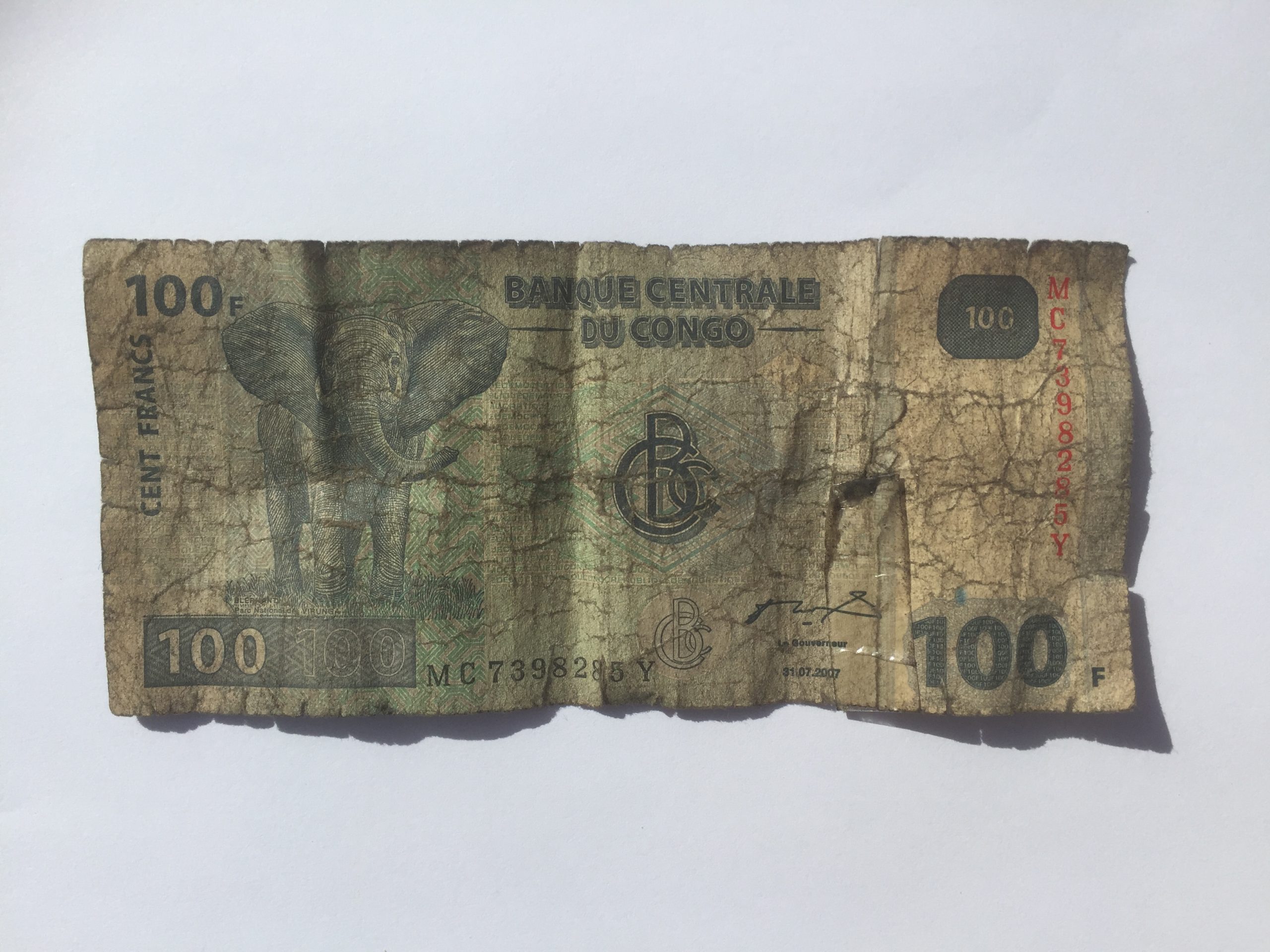
HOT FROGS and the monetization of money

In this article, James Shepherd-Barron outlines how the international aid community has succumbed to the inevitability of digitalisation and the associated monetisation of money … the cynical conversion of the public good called cash into its privatised digital equivalent. The process, he argues, is driven in large part by our collective failure to understand the social utility of cash.

Like so many other aspects of our lives, the Covid crisis has forced us to re-examine that which, only a year ago, we once took for granted. One of these relates to our relationship with money. Not the lack of it – which is problematic enough for many of us – but how we pay for the stuff we consume. Stuck at home, we are forced to shop online. And when we do venture out, we find retailers less than keen on accepting the folding stuff. Rumours about possible transmission of the virus via notes and coins, exacerbated by poor risk communications from the World Health Organisation at the outset of the crisis, helped accelerate the pre-crisis trend towards a ‘less-cash’ society.

But is a cashless society really what we want? Is the conversion of cash into its contactless digital equivalent really so desirable? Does the convenience of paying for our shopping with a mobile phone really outweigh the downside to society of deleting cash altogether? Do we even know enough about how cash adds value to society to decide?

Inherent risks involved in the global rush to electronic payments suggests that we will regret it if we let cash disappear altogether.

Because disaster management now prefers ‘cash and voucher assistance’ over distribution of physical relief commodities, it has been possible to test many of these risks in the ‘sandbox’ of humanitarian aid: The practicality of iris and voice recognition as a viable biometric identifier at ATMs and point-of-sale terminals, for example, was – and is being – tested in the ‘real (closed loop) world’ of Jordanian refugee camps; the use of blockchain for keeping identities of persecuted minorities private was fine-tuned for the Rohingya fleeing Myanmar; stablecoin ‘crypto-currency’ options were tested on islanders in the South Pacific following Cyclone Harold last year; ‘smart’ contactless debit cards are being trialled on Syrian refugees in Turkey; and micro-lending apps are in late-stage development in the poorer parts of northern Kenya.

These technologies are all part of a wider push by banks, card companies, mobile network operators and fintech companies to nudge us towards an acquiescent world where we are so comfortable with being able to pay for things electronically that we are happy to wave goodbye to cash forever. Slowly but surely, they have helped us become what Pink Floyd would call “comfortably numb”. We have succumbed to the inevitability of digitalization and stumble around in a state of what Manuel Castells, the great Spanish sociologist, has referred to as “informed bewilderment,” watching societal value being extracted without our permission just as our data and our identities have already been. Like ‘hot frogs’ who fail to notice the water in which they are immersed slowly reaching boiling point, we are aware that the world is changing around us, yet seem unable to comprehend what it means for our lives.

The final scene in this global act of pillage is now underway in the form of the monetization of our money … the cynical conversion of the public good called cash which circulates freely in local markets into its privatized digital equivalent from which value is extracted every time it passes hands in a new form of commercial exploitation. Like the ‘hot frogs’ we are, our collective failure to appreciate the social utility of cash and the role it plays in maintaining the democratic freedoms and civil liberties we enjoy today means that we have not fully grasped the implications of what this means.

There is nothing new in monetization; it has been going on since money was invented, and everybody seems to be at it: our data has been monetized ever since Google first introduced search engine optimisation; Prince Harry has been monetizing his royal status ever since he married Meghan Markle and started forging a career in TV and film production; and Mark Zuckerberg ‘un-friended’ the entire continent of Australia in a spat over Facebook’s monetization of the journalistic endeavours of others.

If we want to avoid the worst excesses of monetization, we need to get over our apparent inability to appreciate that cash has a social utility value far beyond that of the numbers printed on something as intrinsically worthless as a banknote and remind ourselves that cash adds value to society in ways that electronic payments do not and cannot:

First, Cash is resilient: Cash plays a key role in reducing disaster risk, especially in sudden-onset crises where the demand for cash typically triples immediately prior to the arrival of, say, a hurricane and remains higher than usual for months afterwards. When ATMs are sucked out of walls – as they were when Hurricane Maria devastated the Caribbean island of Dominica in 2017 – people quickly learn not to rely on electronic payments. This experience may help explain why cash volumes in terms of both value and the number of notes in circulation, far from decreasing, have been increasing well beyond the rate of GDP growth per capita throughout the Covid crisis.

Second, cash is crucial for financial inclusion: Electronic payments, especially those using smartphone apps and artificial intelligence to rate credit risk, stimulate over-borrowing in low-income societies. Loan repayment defaulting rises as a direct consequence, eventually leading to the downgrading of an individual’s credit score.

FinTech apps hold great promise to help millions of people become financially included and able to manage their finances at low cost and for low effort. But the ability to access easy credit combined with our human bias towards optimism can quickly lead to levels of borrowing that there is no hope of ever repaying. With indebtedness fast becoming a real problem at both household and national level in many developing countries, the promise of financial inclusion quickly turns to the sour reality of financial exclusion. This then serves to deepen the gulf between the have’s and have-nots, the connected and the disconnected.

Third, cash does not discriminate: It is universal; it does not recognise the digital divide and does not rely on a sophisticated payments infrastructure, electricity, fragile software or platforms which are not interoperable. It’s not just that half the world’s adult population did not make a single digital transaction last year – mostly because, being poor, vulnerable or financially illiterate or lacking the means to access the internet, own smartphones or pay for data packages, they could not – but because many – the politically aware and financially literate who fear where surveillance-capitalism (and philanthro-capitalism) is taking democracy – would not. This is as true today in Tigray and Myanmar as it is in Clapham.

And finally, cash is more efficient: It provides better value-for money than its electronic alternatives for two reasons: First, transacting in cash is lower in cost than all other means of payment. According to the British Retail Consortium, debit cards are four times more expensive than cash, representing 8% of merchant transaction costs; second, according to the Cash Learning Partnership, a non-governmental information exchange, when cash recirculates, it generates local economic multiplier effects of up to 2.7 times nominal face value.

Then there are additional social implications connected with electronic payments relating to protection, privacy, fraud, sustainability and empowerment: The means of electronic payments can be switched on and off at will by any dictatorship whose views might not align with yours. Just ask anyone in Northern Ethiopia or Yangon. Our purchasing behaviours are no longer private when we transact digitally; buy a blood-pressure monitor over the internet and watch your health insurance premiums rise. Coincidence? Digital financial fraud is rising dramatically. And the mining of BitCoin consumes more electricity than that used by the whole of Argentina.

We have been caught off guard by our digital illiteracy. It’s as if we are emerging, tortoise -like, blinking and befuddled, into the sort of brave new world that George Orwell would have recognised. Ever so slowly, we wake to the realisation that democracy has been, “sleepwalking naked” as Shoshana Zuboff put it in her book Surveillance Capitalism, “while unprecedented concentrations of knowledge, power and privilege have been amassed at our expense.”

So, if the monetization of our money is the final frontier in a world of surveillance capitalism, where do we go from here?

First, we have to re-assert the basic democratic principle that our money, like our data, belongs to us. It is private. Second, we have to demand that the ability to pay with cash is maintained. Central Banks cannot be ‘neutral’ in this regard; it is their duty to uphold their independence and impartiality by insisting on maintaining a universal cash payments infrastructure which is free at point of use. And third, the full cost of transacting has to be made transparent. Only then, when the opportunity costs are known, will we understand the cost of monetization and the true cost to society of taking away the choice of paying with cash.

The moment is fast approaching when we will have to choose what kind of future for cash we would like to see and that we don’t end up doing more harm to society than good in our self-interested quest for convenience

James Shepherd-Barron is a disaster management consultant and adjunct professor of ‘international disaster management’ at Fordham University. He is also founder of The Aid Workers Union, an online resource for aid workers.

CoVid Lessons Un-Learned

What does the field of ‘international disaster management’ have to teach us about the United Kingdom’s response to the CoVid-19 pandemic?

The United Kingdom is currently experiencing the highest per capita mortality rate in the world from the CoVid-19 coronavirus. This could yet be reduced if some of the key lessons coming out of the field of ‘international disaster risk management’ were applied, including from the Ebola responses in Sierra Leone and the Democratic Republic of Congo between 2014 and 2018. In summary, the main ones are:

  1. Treat pandemics as full-on ‘natural’ disasters and reconfigure the decision-making architecture accordingly
  2. Evaluate performance regularly and transparently
  3. Engage the public via a credible spokesperson, leaving Ministers to explain political decisions
  4. Be consistent and coherent with risk communications
  5. Enhance tertiary and social care capacity
  6. Enhance diagnostic capacity, especially rapid diagnostic testing
  7. Localise the response through bottom-up engagement with communities and local authorities
  8. Incentivise self-isolation through financial compensation and job guarantees
  9. Provide cash transfers, not food
  10. Vaccine ‘wars’ over price and priority are inevitable. Manage expectations over vaccine development, efficacity and distribution
  11. Don’t rely on untested technology, especially mobile phone apps
  12. Ensure the mass media understands its social responsibility during a national emergency and re-roles accordingly. Establish a dedicated 24/7 YouTube channel (see Points 3 and 4)

Pandemics (or major cross-border epidemics) should be conceived of as ‘natural’ disasters rather than outbreaks of disease from the outset. This will ensure the change of mindset required by politicians, the public, and the health community to acknowledge that coordination should encompass multiple sectors and technical disciplines beyond those related solely to medicine and public health. Disasters are not inevitable; they are the result of decades of accumulated risk and deliberate decisions taken or not taken by society as a whole. In this, disasters are social constructs. In recognition of these factors, a reconfiguration of the decision-making architecture beyond everyday crisis management is required so that scientific evidence not only influences political decision-making but is seen to do so. Full engagement of all the sectors and disciplines involved will need the strategic oversight of an independent disaster risk management adviser. At no time was such a person involved in the UK response.

Hold regular real-time evaluations and periodically review performance. UN guidelines exist for this. In fact, in any major disaster response the British government would be the first to complain if the UN did not apply these guidelines. Measure performance against the counterfactual – the model of predicted outcomes that would probably occur if nothing were done – and use ‘net excess mortality all-cause’ and QALYs to justify the opportunity costs involved in health outcomes, not just mortality rates. Publish the dashboard so that everyone can see things like laboratory tests conducted, bed occupancy rates, vaccine deployment, therapeutic development, and ambulance usage in one place. To the extent possible, allow access to the underlying meta-data.

A credible spokesperson fosters trust in a way that a politician cannot. This would not normally be a chief medical officer as the response is not only medical. Nor would it normally be a chief scientific adviser as much of the evidence is anecdotal rather than ‘scientific’. The public need to know the limitations of ‘the science’ and ‘the science’ needs to inform – not lead – political decision-making. Attaching high, medium and low indicators of confidence to ‘facts’ which are actually opinions would help build public trust. Scientists rarely agree completely.  David Nabarro of WHO, Jeremey Farrar of the Welcome Foundation or Mukesh Kapilla of Manchester University, all of whom have real-world experience not just of outbreaks, but of disaster management, academia and science, would have the kind of profile needed.

Risk communications is not the same as ‘Strat-Comms’ (strategic communications) and needs to be STARCC (strategic, timely, actionable, relevant, consistent, and coherent). Messaging is more effective when coming from trusted sources, including celebrities. It’s about addressing rumours and the inconsistencies of human behaviour, not just the implacable rationality of epidemiological data. Every word matters. ‘Boosterish’ dissembling by politicians undermines public health messaging. The public were very quick to spot that vaccines “offered” mean something very different to vaccines “given,” for example. Technical issues like the sensitivity & specificity of rapid diagnostic tests should be explained in detail. It is only this level of knowledge that leads the public to understand how vaccination coverage, however high it is and however effective the vaccine, means that those vaccinated “do not become invincible overnight.” Don’t blame the public if messages like this have not been understood. Consider changing the school curriculum.

Signal that decision-makers understand the difference between the Hippocratic imperative of saving every individual life versus the public health imperative of saving populations. Wearing or not wearing of face-masks is more about this difference than it is about the type of mask or the opportunistic risk of putting them on and taking them off.

Over-centralisation should be avoided, especially as it means introducing inexperienced private-sector partnerships. This means that contact tracing and laboratory diagnostics should be conducted as close to affected communities as possible, preferably by government-led public health services whose capacities have been enhanced.

Pharmaceutical companies are not charities. They are in competition and will only invest in public goods if incentivised to do so, including guarantees that R&D costs will be underwritten by government in exchange for ‘no-profit’ distribution for a limited period. Because of this investment of public money, terms of commercial contracts should be in the public domain. They should not be expected to develop vaccines on a not-for-profit basis, although they should be expected to support equitable distribution. Overt and covert manipulation of research data should be expected. Usually, vaccine efficacity data from clinical trials is not emulated in the real-world and there can be considerable lags in production, which means that public and political expectations over when and how much immunity is conferred through mass immunization need to be managed.

Be wary of un-tested technology, especially when it involves mobile phone apps which, like cash transfers, are fragile at the best of times. Mobile phones, however, have a major role to play in coherent risk communications, especially when linked to location. The Red Cross are world leaders in this.

The media – all of it, not just public broadcast media – has a social responsibility during a pandemic response and needs to re-role accordingly. Absolute and Relative figures should always be used to avoid giving a false impression of what is going on. When the ‘science’ is open to interpretation, expectations need to be managed accordingly. TV and Radio hosts and their producers should take extra care to avoid creating false narratives through provocative framing of apparently innocent and binary questions and then holding politicians to account for “over-promising and under-delivering”. This is not accountability, this is sensationalism. And it can quickly confuse the public and erode trust in the wider effort. All so-called ‘facts’ promulgated via social and mass media should come with a ‘confidence indicator’ attached (as the IPCC does when reporting on climate change, for example). Consideration should be given to establishing a dedicated TV and Radio channel

End

James Shepherd-Barron is a practising international disaster risk management consultant who advised the British government on its Ebola responses in West Africa during the period 2014-2018. He is a Professor of International Disaster Management at Fordham University in New York and author of Absolute Disaster.

HOLE IN THE WALL (Book Extract)

INVENTION OF THE CASH MACHINE

Copyright 2021

For further information or to query anything said in this extract, please contact [email protected]

JAMES SHEPHERD-BARRON

“A fascinating personal insight into an important yet largely untold piece of social, financial and business history.” ( Hugh Carnegy, Executive Newspaper Editor, Financial Times )

LOOKING BACK ON IT NOW, it must have been the Easter holidays. Two things make me fairly certain of this: One is that the day, being bright and clear, was bitterly cold. The other is that I was on my way to see the dentist in London. As with most small boys I imagine, this annual event was not looked forward to much. But the dreadful anticipation was always tempered by the promise of some compensatory special event. Usually, this would be a West-End matinée, a visit to a museum, or, best of all, a couple of hours across the Thames at the Battersea Fun Fair. But this time, it was different. For a start, there was only me. And second, my Dad was taking me to the Royal Mint “where money is made.”

I only found out about this during our fifteen minute drive into Dorking station that morning. Mum had dropped us off in the station wagon – a gigantic gas-guzzling legacy from our early years in the United States – with a parting rejoinder to my Dad not to let me eat anything until after the ordeal with the dentist was over. Dad, of course, promptly ignored this advice, buying me a chocolate bar from a vending machine on the platform as we waited in the hustle of the commuting melée for the London-bound train.

Later, as the train clattered and rocked its way through the dreary landscape of commuter-belt Surrey, I asked Dad why we were going to the Royal Mint[1] and not Battersea Fun Fair. Secretly, I was rather disappointed. Watching money being printed didn’t sound like much fun. Folding away his newspaper, he leaned forward to explain, in an almost conspiratorial whisper, that I was “in for the treat of all treats … that I was to see how ten shilling (‘ten bob’) notes[2] were made … and would be the first boy ever, in the whole of England, the United Kingdom, and the whole world, to do so.”

Satisfied with this, I sat back and unwrapped my chocolate bar. I must have been more or less the same age as he had been when photographed with his mother riding a donkey in India.

The tooth-ache was forgotten within minutes of arriving at The Mint which, in those days, was housed in a grand Georgian building near the Tower of London. First, I watched an old man wearing eyeglasses – I recall his name being Fred, but I might be wrong – finish engraving the die which was to be part of the printing process. While letting me hold the die – making me potentially the richest boy in the world, or so I thought in awe – he explained how ‘ten bob’ banknotes required multiple such dies, all created by hand by master engravers who never meet each other so as not to be able to divulge any of the secrets of their work. Then, under the watchful eyes of uniformed security guards, I witnessed a ‘top secret’ test print-run[3]. Fred explained the vagaries of ‘ink and rag (paper)’ while this was going on, but much of what I was being told went in one ear and out the other while I focused, fascinated, on what one of his colleagues was telling me about the ‘security devices’ that would eventually end up being incorporated into the final product.

What I remember more clearly than any of this, though, was Fred’s explanation of why all banknotes in the world not only have unique serial numbers, but why these numbers appear twice on the same note … (an historical anomaly which is explained in more detail in the chapter on Cash).

Returning home late, my Dad and I went shopping the very next day, a Saturday, and it was then that the second, seemingly innocuous, event that would change our world forever took place.

I had accompanied Dad to the bank in the hope that an advance on my pocket-money might be forthcoming because I was itching to buy the ‘must-have’ fashion item of the time, a ‘superball’. It wasn’t the closed doors that made me realise my hopes were about to be dashed, but the fact that this was the first time I ever heard my Dad swear. Since I didn’t know what the ‘F-word’ meant at that time, it wasn’t the word itself that shocked me so much, but the vehemence with which he said it. I remember him grabbing my hand and marching me up the Dorking high street in a tower of rage to a garage whose kind owner cashed him a personal cheque instead.

These two, seemingly disconnected, events played an enormous part in defining the ATM’s story.

Invention is more perspiration than inspiration.

As with most aspects of clarifying ‘who invented what, and when’, the answer to the question “who invented the ATM?” is not as straightforward as it first appears and is not without controversy. There have been arguments for years over who should officially go down in history as the ATM’s inventor. The answer depends in large part on how the question is interpreted. It depends, in other words, on how the words ‘invent’, ‘automated’ and ‘teller’ are defined. It also depends on the timelines of history, the prevailing cultural attitudes of the day, and your views on whether it takes more than one person to invent something.

Before examining this evidence – some of it not seen before – it’s first worth considering what constitutes an ‘invention’? Although referring to another age, this historical anecdote provides some context which should help us work out a suitable definition for ourselves:

With the possible exception of paper money, the plough, or the wheel, few inventions have influenced human history more than the stirrup.  Historians believe that the competitive advantage afforded by this simple piece of technology – a hoop of metal attached to a horse’s saddle with an adjustable leather strap – gave rise to a new form of mounted warfare against which foot soldiers were no match. This most basic of  technologies conferred such advantage to mobile mounted cavalry that traditional forms of set-piece warfare were rendered obsolete almost overnight.

It doesn’t take much imagination to realise that early bareback riders, especially those festooned with weapons of one sort or another found mounting a horse something of a challenge. Without stirrups and with only the most rudimentary of saddles, they spent a lot of energy trying to get on … and, once mounted, trying not to fall off. 

Then, around three thousand years ago, someone added a simple loop of leather to the saddle that allowed the less athletic and more heavily armed rider to mount his horse more easily. From there it was simply a matter of time before someone added the loop to the other side and a new advantage was found … the rider could not only mount more easily but was now much more stable into the bargain, and therefore less likely to fall off in the heat of battle.  Before this simple invention, only highly skilled and well-practiced horsemen were able to ride and wield weapons effectively at the same time.

But this wasn’t all. By 700 AD, Europe began to develop a new form of society whose sole purpose was to support this highly mobile type of mounted warfare, eventually structuring their entire society around the concept of the mounted knight. The material cost of maintaining mounted knights was staggering and the feudal system evolved as a way of supporting this new type of warfare.

No-one is suggesting that the invention of the ATM is on a par with the stirrup, but there are some parallels: First, it was new. Nothing like it had existed before; second, a simple and elegant technical innovation provided an efficient and cost-effective solution to a problem no-one knew they had; third, entire societies adapted to the new technology; and fourth, the technology itself evolved, giving rise to yet further consequences which had not been foreseen originally.

With this in mind, we have to ask ourselves what exactly it was that Dad was supposed to have invented?

Any meaningful discussion of this subject would necessarily have to start with defining what is being discussed. For purists, a cash dispensing machine and an automated teller machine are different. One definition suggests that a cash machine is a stand-alone device requiring human intervention whereas the ATM is effectively a remote terminal of a bank’s computer network[i]. This would mean that the ATM as such could only have been invented after the invention of linked computer networks … the first example of which, the Ethernet, only went public in 1977, ten years after the cash machine was launched. This would be akin to saying that the light bulb could only have been invented once the electrical supply system had been put in place. But it wasn’t; it was invented decades earlier. If we insist on making the distinction, however, it took about two decades for the cash machine to transform into the ATM.

The ATM certainly met the criteria of a ‘machine’ as it was an externally powered mechanical apparatus made up of several different parts, each with its own definite task, yet which performed a particular function when working together, and did so over and over again. It was, to an extent, also ‘automated’ in as much that, once the user’s identity had been authenticated, it dispensed cash without further human input. But in its original guise it was unconnected, even to the bank in whose wall it was installed, and was therefore in a sense, dumb. Nor did it make use of the magnetic-stripe card still in use today … for the simple reason that magnetic stripes hadn’t been invented by then.

And whether or not it performed the functions of a bank teller – otherwise known as a ‘cashier’ or ‘clerk’ – depends on what you think a bank teller actually did back in the mid-sixties. Officially, their job was relatively straightforward: To pay out and take in cash over the counter. In practice, they spent most of their time counting the stuff. Well, the ATM performed that function really well: it dispensed cash. Input of a personalised token, when matched with a four-figure personal identification number in real time, resulted in cash being delivered to an authentic customer whenever – and, to an extent, wherever – he or she wanted it. Furthermore, it was delivered correctly and quickly, safely and securely, day and night, come rain or shine. No bank teller could do that, and no precursor – including CitiBank’s Bankograph which had debuted in New York a few years earlier, or the Bank of Japan prototype trialed in Tokyo in 1966 – had been able to get anywhere close to achieving such a successful outcome before.

       Invention and innovation are not the same.

If the identity of the person who first came up with the idea of a working cash dispensing machine is not in dispute, the identity of the person – if indeed there is such an individual – who transformed the concept into something more akin to the multi-functional connected ATM we recognise today, can legitimately be debated.

Modern invention, as we will go on to see, is a blur of competition and collaboration. Deserving individuals – such as John Glenny of De La Rue who did so much to pioneer application of the personal identification number, or PIN – are too often left out of the fray, becoming casualties in a form of pseudo-intellectual triage driven more by ego than historical fact. The patent record doesn’t always help.

The man who holds the patent to the device in the US is Don Wetzel, credited in the Smithsonian National Museum of American History in Washington DC as the machine’s progenitor. In 1995 the Smithsonian recognised Docutel and Wetzel as the inventors of the ATM[4]. Wetzel, however, did not hit pay dirt on his ‘invention’. His name was on the patent (along with two others), but Docutel owned it. “I never got any royalties,” he says. “But I was treated very well by my company.”

The same cannot be said of De La Rue and Dad. Despite later successes with Security Express and Courier Express, he was never rewarded in any way by this very conservative and risk-averse British company, and although everyone thinks he must have been fabulously wealthy on the royalty payments generated by his invention, he never received more than his salary and pension. As a ‘salary man’, he never thought it should be any other way.

The man who holds the patent for security aspects of the device in the UK is James Goodfellow. But the ATM’s roots can be traced further back to someone named Luther Simjian, who put together a machine that allowed customers to deposit cheques and cash. He persuaded New York’s First National City Bank (now Citibank) to give it a try back in the early 1960s, but customers had little use for it, mostly because it wasn’t very reliable. “It seems the only people using the machines were a small number of prostitutes and gamblers who didn’t want to deal with tellers face to face,” he later wrote.

As recently as October 2016, James Goodfellow was inducted into the Scottish Engineering Hall of Fame as “Inventor of the ATM”. A few months earlier, in April 2016, the Guardian newspaper in the UK ran an article also citing him as the “unequivocal inventor of the ATM”. This would appear to be a logical conclusion. He was, after all, the patent holder. But, as with everything else in the murky world of ‘inventology’, the truth is somewhat different.

In the Guardian article, Goodfellow talks about his role, including how, as an employee of an engineering firm in Glasgow, he was tasked with designing and patenting a machine which would issue cash on demand to a recognised customer at any time of day or night, seven days a week. The solution involved coupling something only the user knows – the PIN –  with something the user owns – an associated coded token – sent to them through the mail by their bank branch. This token took the form of a plastic card with holes punched in it. When inserted, a card reader matched the position of the holes to the sequence in which four of ten buttons mounted on the machine’s facia were pressed. “This pretty much describes the ATM today,” the article correctly points out.

After little more than eighteen months of testing, the first Chubb-branded machines to use Goodfellow’s system were installed at branches of National Westminster Bank (later to become NatWest) in August 1967. This was nearly two months after the De La Rue version was unveiled.

So, what was it about the original De La Rue machine that made it first, and made it so different? As with the Chubb machine, customers could withdraw ten pre-packed one-pound notes using a special token, though the De La Rue version took the form of a paper voucher. These vouchers were deliberately designed to look like cheques as customers were already familiar with this method of getting at their cash. They were supplied in packs of 10 and issued free to approved customers only, each of whom was sent a personal identification number (PIN) in the mail. Six digits were used during the testing phase, but, on the advice of my Mum, who said six was too many for her to remember, and my eight-year-old brother who said that four would probably be enough anyway if a ‘three-strikes-and-you’re-out’ rule was applied[5], this was reduced to four by the time of the ATM’s launch.

A single voucher was placed in the drawer of the ATM – or “robot cashier” as they were known by bank staff at the time – which the customer then closed. It took about 20 seconds for the machine to verify the validity of the voucher after which a green light on the facia blinked on. Seeing this, the customer then used the keypad to enter his or her PIN which, if it matched the coding sequence on the previously inserted voucher, illuminated another green light to signal that the drawer had been unlocked and that the packet of cash which had replaced the voucher could now be extracted.

The authentication technology came in two parts: The first was kept extremely ‘hush-hush’ for obvious reasons and involved the use of mildly radioactive ink when printing the voucher. Once inserted, a small Geiger-Muller counter verified that the voucher was genuine. The press were told that the ink was not radioactive, but magnetic[6]. One reason for this minor subterfuge was a fear that the public would not accept the use of radioactive ink when memories of the nuclear bombings of Hiroshima and Nagasaki were so fresh. The other reason was to deliberately lay a false trail for anyone intent on misappropriating the technology. This was especially important as the whole concept was not under patent protection at this time. But we will come onto that.

The second – and parallel – method of authentication was more visible and involved a sequence of holes drilled through the voucher through which a light was shone. Encoded within the sequence was the four-figure PIN which could be ‘interpreted’ by a simple array of photo-receptors. If the numbers were correct and, crucially, entered in the correct sequence, the drawer release mechanism was activated once more, and the customer could open it to find the voucher replaced by a packet of cash.

In essence, the only difference between the two machines, then, was that the De La Rue machine didn’t use a plastic card, preferring instead to apply technology it already knew about through its involvement with automated petrol pumps … perforated paper cheques overprinted with mildly radioactive Carbon-14 ink[7]. In the article, James Goodfellow accepts he didn’t invent the concept of a cash-dispensing machine. Nor did he invent the accompanying four-digit personal identification protocol we know as the PIN, as the whole concept had already been passed to the Kelvin Hughes engineers by Tom MacMillan of Nat West[ii]. What he did invent, however – and go on to patent – was a new, more sophisticated, and more elegant way of applying it using Hollerith ‘decade’ switches[8]. In this, he was like James Dyson … he had invented a better mousetrap.

The same article went on to suggest his involvement with the ATM was similar to the Wright Brothers in that they didn’t invent the concept of flying either … everyone was trying to do it. But they achieved the first successful powered flight and so earned the credit for inventing the aeroplane. To add insult to injury – and as contributors to the newspaper’s blog later pointed out – this whole affair was akin to calling a train driver the inventor of public transport. He was employed by a company whose client, Chubb, had contracted his firm to come up with a way of automating the dispensing of cash to legitimate recipients, so he did.

Sadly, although he was no doubt unaware of this at the time, he was applying secret ideas that had already been developed by someone else … the Barclays-De La Rue team. It is therefore a mistake to claim, as the Guardian newspaper has done and as the Home Office in the UK is also now doing in its ‘nationality test’, that James Goodfellow is the ATM’s inventor.

The ATM’s development was a team effort.

Interestingly, Dad himself never claimed to be the ATM’s ‘inventor’; as has already been mentioned, that accolade was pinned on him later in life after a TV documentary by the Discovery Channel in 1995 referred to him in those terms. This was then further substantiated in The Nilsen Report, the Guinness Book of Inventions, and the ATM industry association’s own newsletter. The theme was repeated by various TV and radio channels thereafter, including by the BBC in 1997. 

But could the ATM ever have been the brainchild of a single person anyway? The argument against the ‘great man theory’ of invention is not new and suggests that it wasn’t. In his book The Innovators, Walter Isaacson points out that most innovation is not the product of one person acting alone. He cites the case of the man credited with having conceived the first automatic digital computer, Charles Babbage, and his collaboration with Ada Lovelace, the world’s first computer programmer, without whom his Difference Engine would not have been so very different. His collaboration with Gottfried Leibnitz, the most famous German mathematician of his day, and Alan Turing of Bletchley Park and Enigma fame is highlighted, as is the fact that the British government supported his work to the tune of £170,000, then equivalent to twice the cost of a battleship. Someone somewhere had seen merit in the idea and had ‘sponsored’ it. The book also explores what Ada Lovelace called “political science” … that machines and their creators are not just about cold calculation and mechanics, but about the essence of human creativity. “Those who helped lead the technology revolution were people in the tradition of Ada, who could combine science and the humanities,” he writes. Innovation is all about getting the mix right.

Dad himself was always the first to say the ATM’s development was a team effort. However, as a businessman – not an engineer in the traditional sense like his father – it is true that he came up with the idea, proved the concept, found a ‘sponsor’, and led the team at De La Rue that re-engineered existing components into a new and innovative electro-mechanical device. As such, he wanted to be remembered as a business pioneer rather than inventor.  And, just for the record, he actually thought his pioneering work in setting up Security Express, Europe’s first armoured trucking service, and setting up the UK’s first overnight parcel delivery service, Courier Express, ranked higher in his list of achievements.  He certainly thought they were more fun[iii].

How is a business pioneer defined? Is an inventor necessarily a business pioneer? Should Alexander Fleming be regarded as a business pioneer because his discovery of penicillin led to the mass production of antibiotics? Should Thomas Edison, a prolific inventor whose company grew into General Electric, be considered one? Clearly, just inventing something isn’t enough. The invention – or innovation – has to have real-life application and should have upended old ways of operating and led to the creation of a new business.

There is inevitably a backward-looking component to deciding who is a genuine business pioneer, and who is not. By definition, a pioneer breaks the mould by doing something different, the true importance of which might be hard to identify until years, or even decades, later. Early iterations of the ATM involved refining the process of dispensing pre-counted packets of cash, and it was fully 15 years before its wider potential began to be realised. This retrospective component also tends to favour western industrial economies, not least because of their ability as free-market societies to communicate each successful innovation through advertising and the media. Western economies also have strong legal and patent systems to protect and nurture transformative ideas. The Wright brothers were just as determined to protect their flying machine from unscrupulous competition through the courts as they were in learning to fly. The same was true of Edison’s lightbulbs.

Meanwhile, historians now like to point out that Marconi did not invent the radio any more than Edison invented the lightbulb, or Charles Darrow invent the most popular board-game in history, Monopoly®[9].

We tend to rewrite the histories of technological innovation, making myths about someone who had a great idea that changed the world when, in reality, that person was usually not the inventor at all but the person who knew how to exploit the idea and bring it to scale. Such was the case with penicillin, where Alexander Fleming has been credited with an idea actually discovered and pioneered by a fellow chemist from the same laboratory, Howard Flory.

It was a similar story with the light bulb. Invented by the British chemist Humphry Davy in the early 1800’s, the concept of the electric light bulb spent nearly eighty years being passed from one hopeful physicist to another like an unwanted birthday present. In 1879, an American entrepreneur, Thomas Edison, finally figured out how to make an incandescent bulb that people would actually find useful enough to buy. At least, that’s the story. But Edison did not actually invent the lightbulb any more than Alexander Fleming discovered penicillin. That honour fell to a one-time British rival and later business partner, Joseph Swann. Edison was the one, however, to bring the idea to a scale sufficient for the public to notice, and so came away with the credit.

Edison’s achievement was not the lightbulb per se, but in putting together the electrical systems that contained all the elements necessary to make the light-bulb practical, safe, and economical to operate. He and his team at Menlo Park outside New York had to invent the parallel circuit; a durable glass bulb that wouldn’t explode when hot; an improved dynamo; an electrical conducting grid; capacitors for maintaining constant voltage; safety fuses; insulating materials; light sockets, and on-off switches. Before Edison could make his millions, every one of these elements had to be developed into practical, reproducible components, and eventually fitted together into an integrated functioning whole.

The difference is that innovation takes an existing idea and applies it in a new way, whereas invention demands a radical departure from what is known. Innovation and invention, though talked of almost interchangeably, are not the same thing. Innovation entails using the stuff we already have in better ways; invention involves creating new stuff, new ideas, new machines, from scratch. Innovation is re-engineering, re-purposing, or re-inventing what people already know how to do.

The ATM was a prime example of the latter as it represented a radical departure from what was then considered ‘normal’, and then changed the way we behave. Being able to access our cash anywhere, anytime meant we didn’t have to think about cash at all; cash was as near as the nearest ATM. We bought on impulse instead of planning every purchase ahead of time.  All we had to do was punch in a few numbers and ‘hey presto’, out popped our cash. We didn’t stop to think for a moment on how this miracle happened, or how we were interfacing with a machine on a whole new level to that of a kitchen dishwasher or a track-side vending machine that dispenses cans of warm fizzy drinks or melting bars of chocolate.

Times of rapid social transformation unleashed by technological genius are referred to in the ‘tech’ industries as “Gutenberg Moments”. But the allusion is misleading. First, it took not one moment, but more than fifty years to turn printing with movable type into a flourishing business concern and even longer for Gutenberg’s printing press to change the late mediaeval world. And, just as importantly, he wasn’t alone: like Edison and Marconi hundreds of years later, he was well connected and had business partners. For centuries we’ve clung to the romantic view of Gutenberg, the lone genius. But a closer read of history reveals him as one in a long line of innovators whose success relied more on collaborative teamwork than on vision, imagination, or bloody-mindedness. Without a team behind him, Guttenberg’s effort to complete his invention and bring it to the world would not have succeeded.

It was much the same with the ATM. Its inventor was well connected in banking circles and, through his employer, De La Rue, had access to more or less unlimited finance and engineering talent. The machine’s major components, especially the cheque reader and number recognition technology, not only already existed, but De La Rue already held the patents for each. All that was required was for these pre-existing technologies to be bolted together in a new way such that the idea would become, like Gutenberg’s moveable type, greater than the sum of its parts.

Ideas are cheap. At least, according to Neil Rimer of Index Ventures, a venture capital firm, they are. What is needed, he says, “is not just the idea but the wherewithal to realise the idea … it’s more about mind-set than skill-set.”

“Charismatic original thinkers that can attract a team, convince sceptics that a business opportunity awaits, that have the skills to lead, and who are brimming with ambition, conviction, dedication and passion will always be able to convince investors and customers to come along for the ride,” he went on to say. This describes the early days of the ATM perfectly and was just as relevant fifty years ago as it is now.

But there was another magic ingredient behind the invention of the ATM. Some people refer to this ingredient as ‘luck’, but this fails to capture what happens when new and disruptive ideas make it from the drawing board to the board room. The more correct term is ‘serendipity’ which means something altogether different. Having been brought up on Kipling’s Plain Tales From The Raj, Dad knew what serendipity was.

We think of serendipity as a happy accident; a chain of chance encounters when seemingly random events coincide. But it actually has a very different meaning.

In 1754, Horace Walpole, a well-connected English ‘Man of Letters’, outlined a Persian fairytale about three Princes from the Isle of Serendip who had extraordinary powers of observation that would get them out of sticky situations when travelling. This old tale, he suggested, contained a crucial idea about human genius: The Princes were always discovering things they were not in search of. Walpole’s insight was that skill, rather than random strokes of good fortune, was somehow being brought to bear. He coined the term ‘serendipity’ as something people do, not just the consequence of things that happen to them.

It was not just that Dad was frustrated by his bank one morning in not being able to access his cash, it was that he worked for a company that printed banknotes as well as manufacturing the mechanical devices that counted and sorted them. He had started up Europe’s first armoured trucking firm that distributed the stuff too. Although he was unaware of it at the time, he was also imagining a solution to a problem he didn’t know existed … that banks were trying to resolve their differences with the labour unions over Saturday working practices. If motivation is part of the serendipitous process, it’s worth remembering that he was at the same time desperately trying to stop the subsidiary company he was running from going bankrupt.

According to the author Pagan Kennedy, when people unconsciously dredge the unknown they are engaging in a highly creative act. What an inventor discovers is sometimes a solution in search of a problem, but “is always an expression of him or herself.” This describes Dad very well. The idea of the ATM was in him all along. In having lunch with Harold Darvill – a seminal moment, which we will come on to – he may have been in the right place at the right time, but he was capable of seeing patterns that others couldn’t see. “Innovation isn’t all hard work and dumb luck,” she notes, “It’s about paying attention.” According to her, this is how we dream things up that change the world. A surprising number of the conveniences of modern life – smoke detectors, the microwave oven, and X-Ray imaging among them – were invented this way … with someone stumbling upon a new method of doing things, or capitalising on a chance encounter.

The Wright brothers would have recognised the process as it must have been a little bit like the early days of flight: The design team – a rather sceptical bunch of bicycle mechanics – would have understood how wonderful it would be to fly but none of them would have been quite sure what an aeroplane should look like. It would need a power source, but what type? Should it be at the front or at the back? It would need wings, but what shape? It would need ailerons, but what size? Through an iterative process of trial and error, it eventually became clear what the physics could do. What was not known was how to bolt all the pieces together in a way that would lift the whole machine off the ground safely and reliably, and then replicate the process. As a businessman rather than an inventor, however, Dad got it the right way round. He knew what he wanted to achieve; it was just a question of working backwards to achieve it.

Dad was an entrepreneurial Scotsman with a quick, questioning mind. His father was a civil engineer who built things to last. Having arrived one mid-60’s Saturday morning at his bank to find it closed, he became frustrated at not having the freedom to withdraw his own cash at a time and place of his choosing. In that moment, he saw society had a problem. But could there be a practical solution where none had existed before? His epiphany was actually the result of conscious, methodical planning in support of a confluence of ideas, experiences and opportunities … he didn’t actually work out the practical solution until later that evening in his bathtub. This was the Eureka moment.

Arriving at the solution, though, required a form of ‘matrix thinking’ comparable to a three-dimensional game of chess. Such thought processes involve putting order into a rather chaotic process of spotting, incubating and re-combining ideas from many different times, places, and events, and then putting them all together in a way that no-one has thought of before. Applying this sort of logic to the development of the ATM, it could be said that this type of goal-oriented thinking helped shape a highly focused function: an automated machine capable of reliably and securely dispensing cash 24/7 without the need for a human teller.

By virtue of circumstance, he was the right man in the right place at the right time: He was the managing director of a firm that, among other things, produced banknote-counting devices and he had just started up Europe’s first cash-in-transit armoured trucking company. The parent company, De La Rue, printed banknotes. By inventing a machine which dispensed money rather than just making it or moving it around, he brought the business full circle. The engineering achievement of the ATM did not come out of thin air, in other words, it came out of a logical and methodical thought process.

It’s also true that having your mind prepared to exploit an opportunity is just as important as spotting one in the first place. The engineering frame of mind is systematic and especially adaptive towards producing useful and practical solutions. As Guru Madhavan put it in his book Think Like An Engineer, “The engineering mindset sees structure where there is none, and is adept at producing utility under constraints, and making considered trade-offs in the scheme of what’s available, what possible, what’s desirable, and what the limits are.”

But something else was going on; something that in the age before intellectual property theft we used to call ‘reverse engineering’, a concept of ‘backward design’ where the desired outcome is pre-imagined and the engineering is applied in reverse to achieve that goal. For De La Rue, the automated cash-dispenser represented little more than a novel way of bolting together already existing mechanical parts rather than the conceptual paradigm shift it really was. Even when the orders began to flow, they never really got the point and, thinking they could not compete with US manufacturing prowess in those post-war years, were content to revert to the OEM model[10] and focus on supplying the components under licence, leaving the business altogether some fifteen years later.

In imagining, creating and refining the systems and mechanical processes of the ATM – including security, accountability, data protection, and resupply – Dad was working entirely backwards to form a framework for what we now call “telematics” … a system of systems that was eventually to unite computing, telecommunication, logistics and encryption technologies.

But he couldn’t conceive at the time what disruption this would cause, nor that such disruption would be his legacy; he just wanted to get hold of his money at a time and place of his choosing, not that of his bank manager.

The ATM became the icon we didn’t know we needed.

The operating principles of the ATM are based upon reliability. From day one, customers had to trust the machine. This meant it had to work and work every time. It didn’t just have to provide the correct amount of money to the owner of that money and nobody else, but it had to prove it had done so by leaving an audit trail. Being exposed to the elements, it also had to work equally well in heat-waves and blizzards. Realising this, Dad ensured that the ATM was always over-engineered and that redundancies were built in from the start … ‘redundancy’, in engineering terms, being the duplication of critical components.

It didn’t work very well at the start, however, and even the inaugural opening event at Barclay’s Enfield bank branch in north London had to be faked, with Dad later confiding that he himself had to manually dispense the first ever packet of ATM cash to the actor Reg Varney[11] who was waiting on the street outside in front of the world’s TV cameras to accept it.

“Being a British inauguration, it was a low-key event compared to Tokyo,” Dad once confided during an industry dinner in 2008. “We opened Japan’s first ATM for Mitsui Bank in the Ginza district in front of a crowd of over 10,000 people. This brought the place to a standstill, largely because of the large neon sign 15 floors in height which said ‘get your cash here now!’ which the Japanese public interpreted to mean ‘get your free money here now!’ It was absolute chaos.”

Early testing had to be conducted in cold and wet conditions as the machine was to be mounted on the exterior walls of bank branches across the south-east of England in the first instance. The location had to be kept secret for fear of industrial espionage. Being almost perpetually cold and wet, Scotland was chosen as one of the ideal candidate locations. But this was quickly ruled out on two grounds: First, Dad’s father-in-law, who just happened to be chairman of The Royal Bank of Scotland at the time, had already told his son-in-law quite plainly that perceptions of nepotism could not be tolerated, and that his bank could therefore not be involved with the cash machine project  in any way[12].

There was a serious second factor to consider too, which was that it was by no means clear that automation would be accepted by the British public. There was a very real fear that the machines would be vandalised by those who feared – then, as now – being rendered redundant by automation. As it happened, the first six prototypes were repeatedly sabotaged by having honey poured into the delivery tray, and for a while had to be guarded by the police.

Instead, on the basis that it was not only cold and wet, but that its good burghers were unlikely to communicate too readily with nosy journalists, Zurich in Switzerland was chosen as the proving ground. Everything went well enough through the winter months of 1966/67, except for one persistent malfunction: Every once in a while, the machine turned itself on without anyone asking it to, and proceeded to spew Swiss Francs all over the pavement. One such test – which Dad and the De La Rue executive team had flown over to observe – ended up with them all scurrying about in their pin-stripe suits on their hands and knees in the snow trying to stop a blizzard from blowing the notes down the street. Some of these notes were collected by Swiss passers-by who handed every note back. Such honesty so impressed Dad and the De La Rue directors that much of the ATM’s future development – for instance, the testing of the radioactive ink, and blast-testing of the vault  – was also later conducted in Switzerland.

After much head-scratching, it eventually dawned on the engineers wrestling to solve the problem of these seemingly random acts of generosity that they were initiated when passing tram-cars ‘sparked’ the overhead power cables. ATM’s have been protected from such short-circuiting pulses ever since.

Another feature developed in Switzerland was the exterior cladding. Nobody really knew how secure an ATM needed to be; all they knew was that it would be exposed to the elements – including extremes of hot and cold, as well as rain and snow – and therefore to passing criminals. Being used to vaults, Barclays had already insisted that the ATM’s interior vault be constructed to the same specifications as those in their basements. Using much the same logic, this was used for much of the exterior housing, too, with a sheet of brushed stainless steel used for the fascia. Dad and his engineering team thought this a bit over-the-top at the time, not least because they estimated it would take over six hours for thieves with blowtorches to cut through it. It would also considerably increase the weight of the machine, making it a challenge for those who had to install it into the exterior wall of a bank. Discussions with Barclays over what colour the machine should be were short, however, as the high tensile steel meant that it more or less had to be “any colour as long as it’s brushed metal grey.” But, inadvertently, and not by design, this engineering-led solution gave the ATM its rugged and dependable appearance which focus groups would later confirm contributed to people’s trust in the machine. 

The thickness of the steel gave rise to another problem which, with the UK’s weather in mind, had not been anticipated: Winter temperatures in Zurich are very much colder than those found in the temperate climes of the UK, and rarely rise above freezing. The working parts began to freeze solid. To get round this problem, heat sensors were installed so that when the temperature fell to near zero, the metal facia heated up to stop ice from forming over the dispensing mechanism. This approach to solving problems through over-engineering was typical of the early years of the ATM’s development. Despite the UK being nowhere near as cold as Switzerland, the heat sensors remained, and most ATMs manufactured today have them fitted still.

         The ATM deserves its foundational myth.

Nicolai Tesla, the genius behind much of how electricity is used today, thought a lot about the nature of invention. In 1919, he wrote: “The progressive development of man is vitally dependent on invention. Its ultimate purpose is the complete mastery of mind over the material world.” This pithy quote hits the nail on the head. Too often, the idea of invention is undervalued, both by those who seek financial reward for the investment of their time or money, as well as by society at large. The printing press, the lightbulb, and the internet are very different in what they do and how they do it, but all were inventions. We tend to take technological breakthroughs like these for granted, forgetting that our world would be a very different place today without them. The Wright Brothers bent quite a few airframes before finding one that actually got off the ground.

It was like this with the ATM. A man had an epiphany out shopping with his son one Saturday morning; thought about it in the bath that evening; discussed it with his sceptical wife the next day; went to work on the Monday and spent the rest of the day persuading all five of his equally sceptical employees – all of whom were facing imminent redundancy – that the idea was worth developing; received their first order a week later despite not knowing if the idea was even feasible; and then launched an unfamiliar technology on an unsuspecting public who, although initially bemused by the concept of instant gratification, went on to embrace it with such fervour that it is nowadays difficult to imagine life without one on every street corner. 

Although no longer anchored in the romantic myth of the lone genius, ground-breaking stories from a bygone era like this scream out for a foundational truth; a story of vision, dedication, and engineering brilliance that eventually overcomes every hurdle to end up changing our world for the better, forever. National, scientific, political, and industrial icons are founded on such myths. Yet neither the ATM nor its inventor ever acquired mythical status … which is a little surprising given the ubiquity and longevity of the machine and the multi-billion dollar industry it went on to spawn.

Like the light bulb, the ATM was a failure at first. It has been argued that this was partly because the initial order was restricted to a single client, Barclays Bank; a monopolistic decision which, so the argument goes, hampered others from developing their equivalent machines. This takes a rather linear and myopic view of history, divorcing the story from the context of the time. Geniuses are important, but their achievements have to be seen in the context of the times they lived in, and the people with whom they collaborated.

In the mid-1960s there was little idea of how innovation should best be commercialised. Collaboration and sharing – what we would today call ‘open-sourcing’ – were quite normal. But running off with someone else’s intellectual property, as the National Westminster Bank (now part of the Royal Bank of Scotland) did with the ATM, was considered as unethical then as it would be now. My Dad used to say that “The days of the ‘word-is-my-bond’ handshake ended with the ATM’s arrival.”

The debate over whether innovation is better served by sharing intellectual property or by protecting it has become more heated since the unveiling of the world’s first working cash dispenser in those far-off, black and white days of 1967. But the nature of invention has been ever thus.

The days of the ‘word-is-my-bond’ business handshake   ended with the ATM’s arrival.

As with any other complex technology, cash-dispensing machines resulted from a long sequence of innovation, and not just by one company. June 1967 saw the arrival of the much-celebrated De La Rue automatic cash system known as DACS. Within weeks of its debut, two other independently engineered devices were unveiled. The first was the Bankomat which was installed in Uppsala, Sweden on 6 July. While the DACS was activated by a paper token, the Bankomat used a plastic card with an encoded serial number which was read by an optical device.

Also that month, the Chubb MD 2 was launched in the UK. This machine was activated upon insertion of a plastic card with perforated holes; a variation of the PIN concept, but essentially the same idea.

A third British team, this time from the Midland Bank (today HSBC) conspired with a small engineering firm called Speytec to come up with yet another version. Being the second biggest clearing bank in the UK, the Midland team were members of the original De La Rue-Barclays development group. They soon spun off, however, to develop their own adaptation. This version used a plastic card with a magnetic stripe embedded in it that stored a secret six-digit PIN which was returned to the customer after the transaction. This gave rise to a number of security challenges which the other two versions had not had to face. One of these was that the number of times the card could be used had to be restricted, a challenge eventually solved with the help of the National Physics Laboratory. As with the four-digit PIN concept, this team was well aware of De La Rue’s ‘three strikes and you’re out’ feature. Legal wranglings over this and related issues meant that the design couldn’t be patented until September 1969.

Nevertheless, the Speytec machine, now with support from the Detroit-based Burroughs Corporation, went on to be deployed in large numbers, not just by the British savings banks, but in the US. The Chubb MD2 and Swedish Bankomats were highly successful, too, and became the machines of choice for many banks across Europe, in Canada, and even into the Soviet Union.

These early devices were not developed independently of each other, but were the product of collaboration between bankers and engineers in the UK, Sweden, and Japan. In the early days of development, the ‘trade secrets’ that made the machine work were shared amongst them all. As a boy, I would regularly be introduced to visiting Japanese businessmen who would stay overnight at our house outside Dorking, one of whom, in 1966, was so impressed that I was learning judo at school that he bought me a samurai helmet as a gift. I have it on my desk at home still.

The original ATM was ‘cobbled together’

using parts that already existed.

As with most inventions, the early days of the ATM were plagued with operating ‘hiccups’ and the rectification of design flaws. The first cash dispenser, the De La Rue DACS, was, quite literally, cobbled together using parts that already existed. When a single component broke, the entire machine had to be dismantled, a process that could take days if not weeks. Operation was hardly ideal from the customer’s perspective either; one-time-use vouchers either had to be purchased from a teller before they were redeemable, all plastic tokens had to be returned by post for re-use. Withdrawals were limited to a single transaction per day and were only possible at the customer’s own branch. It took years before it was possible to access your money from another branch, and even then it had to be from a branch of the parent bank. Managers at all levels within the main commercial banks thought the idea of the ATM would never catch on. “People,” they would tell themselves, “like dealing with tellers.” With each machine costing thousands of dollars (over $30,000 in today’s money), they also thought they would never get a reasonable return on their investment despite the fact that, in theory, fewer staff would need to be employed.

The early devices worked as stand-alone units, and most ate the activation token rather than returning it directly to the customer. In this, it was operating more like a chocolate-bar dispenser or self-service petrol pump than a modern ATM. Customers eventually began to enjoy the convenience brought to them by this early automation, though, despite the significant technical shortcomings which hobbled their proliferation. And they were, of course, limited to only one function … that of dispensing cash when bank branches were closed. Nevertheless, as cash dispensing is one of the highest priority tasks of a bank cashier or teller, most of those in the cash management industry agree that this machine deserved its acronym, the Automated Teller Machine.

In a letter to Dominic Hirsch of Retail Banking Research, Dad explained the early days of the ATM’s development from his perspective. He had never outlined what really went on in such detail before:

“In the spring of 1965, I had a very personal problem of not being able to cash a cheque on a Saturday, arriving at my bank in Dorking High Street, near where we then lived, exactly one minute after it closed. Instead, I had to persuade my local garage to cash my cheque. Lying in my bath that evening, I thought there must be some way of delivering money automatically through a hole in the bank’s wall, around the clock. There was a way of depositing money all right, the all-night safe deposit box, but no way of obtaining money.

As the bath grew colder, I envisaged something like a deluxe chocolate bar dispenser unit of the type I sometimes used while waiting for a delayed train at the station on my morning commute to work. It needed some form of cheque, some personal input for authorisation, and an audit trail. That much I knew.

Everybody – at least those with bank accounts – used cheques in those days to withdraw cash; a time-consuming process which entailed standing in line at your branch, usually during your lunch hour. De La Rue was the country’s main printers of cheques, but my bit of the company had yet to perfect the paddle-wheel note counter. The only option, therefore, was to pre-wrap a standard amount of money – I thought £10 was enough for anyone’s week-end spending needs – in a ‘brick’, much like a chocolate bar, and exchange it for a specially printed secure cheque. This might prove the audit trail, but I couldn’t for the life of me work out how to tie the owner of the cheque to the machine so that stolen cheques couldn’t be used.

Some form of personal identification number was clearly needed, as anything more fancy, such as fingerprint or voice recognition, did not exist except in sci-fi movies. As I levered myself out of the bath, I thought a six figure number would do it. My Army number was a six figure number, and, like any former soldier, I could still remember that. I went downstairs, and outlined the idea to my wife, Caroline. She listened, said she couldn’t understand why anyone needed to obtain cash out of banking hours, and then said, ‘anyway, I can’t remember more than four numbers at a time.’

I mused about this through the rest of the week-end, while mowing the lawn and teaching the children, then aged five, eight, and ten,  how to do parachute rolls. ‘Green light on, stand at the door … Red light on, GO!’ One after the other, they jumped out of the willow tree, bending their knees and rolling away into the long grass. They never seemed to tire of this, but I was distracted.

First thing on arrival at the office in Regent Street in London on Monday morning, I gathered the team – all three of us – round the table and outlined the problem[iv]. The bottom line was, could we invent a stand-alone device that would deliver cash through the wall of a bank? We discussed the security options: Carbon-14 marking of cheques – we had been working on something similar involving Geiger counters with a school chum of mine, Dan Stanley, who was Chairman of Pye, the electronics company, so knew that this might be feasible – retinal scans, fingerprint, signature, and voice recognition, that kind of thing. I had recently had cause to see the Foreign Office’s filing system, and knew that at that time they punched sequenced holes in cards and then shone a light through the stack to see if any card fitted the criteria they were searching for. It was elegant, but not very accurate. We needed to be 100% accurate.

Having agreed the performance specifications – ‘The machine must incorporate a personalised authorisation system; leave an audit trail in the dispenser; and deliver a standard batch of cash through a handle-activated drawer; the whole operation to take no more than 30 seconds’ – I asked them to go away to think about it and re-convene in 48 hours.

On Wednesday morning, back-of-an-envelope calculations suggested that the idea was feasible, at least from a technical point of view, as long as we could control machine-readable codes and their related security ingredients. Everybody, though, agreed with Caroline’s observation that customer demand did not seem to be there. One thing we did agree on, was the four-figure Personal Identification Number, from then on called the ‘PIN’. Little did any of us realise it at the time, but Caroline had just set the global standard which is still in use today.

On Friday, wearing my other hat as Chairman of Security Express, I was due to host one of our regular monthly lunch meetings with one of the Clearing Bank general managers. We rotated the invitation, and, this time, it happened to be the turn of Barclays Bank. At the time, Barclays was the world’s fourth largest bank, and we had a contract to move their money to and from over two thousand of their branches. Their Chief General Manager, Harold Darvill, turned up early at my suggestion, mostly because I wanted to discuss cash sorting challenges across the nation.

Emboldened by my second Pink Gin – and doubtless he with his – I drew him to one side as we were going in to lunch and asked for a minute-and-a-half of his time so that I might put our embryonic cash dispenser idea to him. John Finn, our financial controller, was with me, and said it took less than a minute for Harold to stop me in mid-flow and say, ‘John, if you can do it, we will buy it. We’ll finance the development costs and buy a few hundred devices if the prototypes work out.’

The team got to work that afternoon, but more in hope than expectation, fully thinking that Harold would call on Monday morning saying that he had re-considered over the week-end. Far from it. The next Monday afternoon, the Deputy Chief Executive of Barclays arrives in the bank’s Rolls Royce at twenty minutes notice – I remember it clearly, because our office was so small, we couldn’t find a parking space for it – and wouldn’t leave my office until we had hammered out a letter-of-intent to proceed together. We agreed to develop six working prototypes, followed by 250 to be delivered in batches of 50. The specification and price was to be agreed between ourselves and the bank’s Operations & Management Department. On leaving, and almost as an afterthought, he turned to me and said, ‘John, do whatever it takes and spend as much as you need. Let me know if you have any problems.’[v]

Can you imagine? A Eureka moment in a bathtub one Saturday, an internal brainstorming on the Monday, a slightly wider feasibility meeting on the Wednesday, a sales pitch on the Friday, and a signed letter-of-intent and promise of a large order the following Monday. All that in little more than a week.

What I did not know at the time, was that, by pure chance, Harold Darvill had attended a meeting just the day before our lunch together with his Clearing Bank colleagues, where they had discussed Union demands to either shut banks altogether on Saturdays or pay the tellers substantially more to open up for cheque-cashing. In the early 1960’s, banks in the UK were under pressure from employee trade unions for access to banking during normal working hours. Banks wanted to be closed on Saturday mornings shortening the work week. Since banks were already closing during the week at 3.30pm each day, a method had to be found to provide an acceptable level of service for customers who work during banking hours. No bank service on Saturdays and closing the bank two hours before most people leave work was starting to be unacceptable to modern work hours. An automatic cash dispenser was seen as the solution. What was to become known as the De La Rue Cash System, or DACS for short, gave the banks the answer they were seeking, not necessarily connected with efficiency, but certainly with customer service. This sort of lucky timing cannot be engineered in advance. Either way, De La Rue Instruments was reprieved in the nick of time.

The R&D team quickly expanded from its De La Rue Instruments members, to include the Head of Organisation and Method from Barclays, Ron Everett, and a small group from Pye Electronics in Cambridge. Pye had a good model shop, and extensive knowledge of working with Carbon-14. We had the experience of cheque printing and cash handling, whilst Barclays were experts at running internal banking systems.

It took us over two years to go from conception to first working prototype. One of the main stumbling blocks was obtaining approval from the UK Atomic Energy Agency (AEA) to use radioactivity in the public domain. But, as the use of a Geiger-Muller tube to read the principal cheque was key to our security approach, we had to accept their slow workings. This approach was eventually vindicated when the equivalent atomic agencies in Italy and Switzerland allowed the system to be used in their countries.

In practice, we ended with a special personalised cheque over-printed with Carbon-14 impregnated ink – a security feature used in some high denomination banknotes even today – and punched hole codes in the cheque which could be read by light emitting diodes (LEDs). The customer would open a telescopic drawer, lay the cheque on the positioning pins, close the drawer, type in a four-figure PIN, and then, if the LED readings and PIN matched, open the drawer again to find the cheque had been replaced with a packet of ten £1 notes.”[13]

In the notes of his ATMIA/RBR after-dinner speech delivered on 14 April 2008 in London, Dad gave an overview of what happened next:

“I had the fun of selling the world’s first cash dispenser, the DACS, to Barclays bank, the second to the National Bank of Switzerland in Zurich, the third to First Pennsylvania Bank in Philadelphia, and the fourth to Mitsui bank in Tokyo. All were firsts in their world.

In each case we did the pioneering job which in turn woke up the market to such an extent that I rapidly deduced we should stay only in that bit we knew the most about, the electro-mechanical dispensing mechanism. We, De La Rue, remained the world leader in these units until about 1982, a position which provided us with the income stream to get us into cash processing i.e the sorting, counting, and packaging of currency notes in circulation.

We got into this business shortly after the Bank of England’s chief engineer told me at a lunch in 1969 to celebrate the commissioning of the bank’s first and very own internal cash dispenser, that I should try to buy Crosfield Electronics as they were having problems with designing and making the world’s first currency sorter. To cut a long story short, we did.

With this, the humble little company De La Rue Instruments, with its eight employees that I had parachuted in from the parent, Thomas De La Rue, turned into a £330 million per annum operation with 2,200 employees in 22 countries worldwide[14]. When the ATM came along, our turnover was £30,000 for the year, from which we made a modest profit of £3,000.

The US part of the story started in Florida in February 1969 where I was the first foreigner ever to be asked to address the American Bankers Association conference in Miami. Together with John Walker, my CEO, we gave a 15 minute presentation on the DACS to polite applause, no questions, and only 12 brochures taken away from the 2,000 provided. The general view in the bar afterwards was, ‘who needs money out of hours anyway?’

Six weeks later, back in London, an unknown voice telephones from the airport saying he is head of operations at First Pennsylvania Bank and his chairman had flown him across the Atlantic at no notice with instructions to “Buy six of whatever those things are that Shepherd-Barron talked about in Miami.” Not a very flattering story, perhaps, but it got us off the ground in the United States and, I believe, was instrumental in opening up the whole US market.

This was greatly helped by the desire of Citibank, then led by John Reed, to set the correct ATM specification for them to use internally, but also for use by their correspondent banks across the country. To this end, they set up a specialist company in San Francisco called Transaction Technology Inc., and where I introduced them to Earl Wearstler, later to become president and CEO of Diebold. The three of us working together came up with the most popular ATM design for use in America, assembled and installed by Diebold. I think it fair to claim that Citibank and Diebold did more to promote the operational concept of the ATM than any other company at the time.

It was around about then that we in De La Rue realised our pioneering days in the ATM were over, and that we should focus on being supplier of mechanical currency-handling systems to the trade instead. By 1982, over 70% of all ATMs in the world were using these devices, all made at a small factory at Portsmouth in the south of England …

… Portsmouth, incidentally, is home to the Royal Navy’s flagship, HMS Victory, made famous by Admiral Lord Nelson at the Battle of Trafalgar. The ship is open to the public, but certain areas such as Nelson’s private cabin are strictly off-limits. It just so happened that the brother of our factory manager, who worked on the ship, had the key to this cabin. Realising the effect having a ‘tot’ of rum from Nelson’s own decanter in Nelson’s own cabin would have on visitors, I would arrange for exclusive access, and it was in Nelson’s cabin, shaking hands over the chart table where Nelson himself had planned the battle of Trafalgar, that most of our principal deals were cemented.”

Patent records do not always prove who

invented what, or when.

The conventional way to protect intellectual property is to patent it[15]. This gives inventors legal protection for their ideas: if others want to use it, they must pay for the privilege. The snag with this is that the idea first has to be published, making it easy for someone less law abiding to steal it. This someone could be a commercial company, an individual, or a country. So, in an age of rampant intellectual property theft, a lot of companies prefer to keep their most valuable ideas under wraps. Not every invention needs to be patented. It was much the same back in the mid-60’s, especially where security protocols were involved … as they were with the ATM.

No one knows how many trade secrets companies keep, or how much they are worth. Some, like customer lists, are generated during day-to-day operations. Others are kept secret because patents typically last only 20 years. Had Coca-Cola patented its secret recipe back in 1886, it would have lost the rights to it long ago, and it would have lost its mystique – and its market – straight away. It’s the same with pharmaceuticals. Once the formula is exposed, the chance of recouping the considerable research and development costs involved reduce considerably.

When Steve Jobs unveiled the i-Phone in 2007, he did more than change an industry. He did more than change the way we communicate, too; he changed the way we think about communicating. Apples’ brilliant new device was the ‘must have’ item of its day – and to some extent still is – and represented a huge advance on the mobile phones that had gone before. It looked different. It felt good in the hand. It had more functions. Its interface was more intuitive. And it was faster. It also worked better. What the i-Phone was doing was taking what had gone before and refining it. As such, the i-Phone represented innovation at its finest.

The ATM which burst onto the Enfield high street nearly two decades earlier did not represent innovation, as there had been nothing like it before. It represented invention. It was new, it was useful, and what it did – although blindingly obvious with hindsight – was not obvious at all. In short, it fulfilled all the requirements for the granting of a patent. Except it was never patented. Why not?

To answer that question, it might be helpful to recall why patents exist in the first place. The system of Patent Protection was established as a trade-off that provides a public benefit, while allowing the patent holder to reap the commercial rewards of his or her investment in time and money. Essentially, the state agrees to grant a limited monopoly to an inventor in return for disclosing how the technology works. If, after technical review by a panel in the Patents Office, the invention is deemed novel, useful and non-obvious, the inventor is awarded 20 years of exclusivity.

A proliferation of patents harms the public in three ways. First, it means that companies will spend more time defending their patent in the courtroom than innovating or expanding market share. Second, it hampers follow-on improvements that take an existing technology and develop it further, often in ways the original inventor had never foreseen. And, third, it fuels many of the patent system’s broader challenges, such a trolling (speculative lawsuits by patent holders who have no intention of actually making anything), defensive patenting (acquiring patents to pre-empt the risk of litigation) and innovation gridlock (the difficulty of combining multiple technologies to create a single new product because too many small patents are spread among too many small providers).

The original ATM consisted of over 300 different electro-mechanical parts. Some of these were patent protected in their own right. The ‘paddle-wheel’ roller that actually counted the cash, for example, had just been introduced to help tellers count paper cash at the bank counter automatically rather than laboriously by hand. Part of what made the concept of the ATM viable in those early days was that the same company, De La Rue, already held the patents on almost all of the working parts. It was just a matter of bolting them together in a new way to do something that until then nobody else had thought of doing.

To reveal how these parts worked together would, in itself, have been worthy of patent protection. But, as with the i-Phone, such a machine is more than the sum of its electro-mechanical parts, and its whole viability rested on the applications built into it, especially its anti-fraud systems. To demonstrate to an unscrupulous criminal underworld exactly how these systems worked would have rendered the whole idea obsolete before it even had a chance to earn the public’s trust. It was a non-starter. And so, as a conscious decision, taken with full legal advice, filing for patent protection was never sought.

It is interesting to note that no one has developed a satisfactory statement of what constitutes an invention. Philosophically, this seems to follow from the fact that an invention is something which is found by reaching out into the unknown. Since an invention cannot be defined by describing something which is still unknown, the only alternative is to state what is not an invention. This is done in patent law by defining what is in the prior art … which includes the entire body of knowledge from the beginning of time to the present. If an invention has been described in the prior art, a patent on that invention is not valid.

In the simplest terms, prior art is simply evidence that something similar has been done before a person applies for a patent. This involves ‘proving’ that this is the case – a process patent lawyers call ‘interference’ – normally by means of written evidence of publication or sale. Interference proceedings, however, are expensive and time consuming, and until they are completed, there is uncertainty as to who actually owns the patent rights. Moreover, most countries in the world abide by a first-to-file system where the patent rights are granted to the first party to file a patent application, regardless of whether they were the first inventor.

Sometimes – and this was the case with the ATM – written evidence can be kept secret i.e not made available to the public. Information kept secret, for instance, as a trade secret, is not usually considered as prior art, provided that employees and others with access to the information are under a non-disclosure obligation. However, the work undertaken by De La Rue and Barclays was under no such non-disclosure agreement. With such an obligation, the information is typically not regarded as prior art. Therefore, a patent may be granted on an invention, although someone else already knew of the invention.

Solutions are far from straightforward, with the main reason for favouring secrecy over patents being security. Elon Musk, for example, refuses to patent technologies developed at his Space-X rocket company for fear that foreign space agencies would simply pinch them.

However, keeping trade secrets is harder than it looks, especially as most such thefts involve insiders. These are typically employees or contractors who are given access to sensitive information, which they then ‘borrow’ – or, depending on your point of view, ‘steal’ – for commercial gain. This, indeed, appears to be exactly what National Westminster Bank did with the ATM. Here is Dad again:

“The original exploitation plan focused on Barclays Operations & Management Department helping us fine tune development to suit banking security requirements. They were happy for us to patent individual electro-mechanical components – De La Rue was heavily involved in security printing and development of similarly sensitive products, so knew full well how important patent protection was – but did not want us to patent the machine as a whole, particularly how the 4-figure PIN was to work. A long debate was held with Peter Etheridge, the De La Rue patents lawyer, and we reluctantly agreed, insisting that Barclays wrote up an accurate note of every weekly development meeting which we could use to prove prior art in the event of any subsequent patent infringement claim.

Whilst working officially only with Barclays, the general managers of all the other main banks quickly learned what was going on and wanted to be involved. Without signing any sort of non-disclosure agreement – we worked on ‘my word is my bond’ in those days – they were invited to join the meetings as observers. Lloyds Bank was happy for Barclays and De La Rue to shoulder the research and development costs and said they would come in after we had honoured our commitment to Barclays for six prototypes and a further fifty machines should they be proven to work. Midland Bank soon went it alone with Speytech-Burroughs, but they never really got going[16]. The National Westminster Bank (later NatWest), then the biggest bank in the country, were not happy to discover some months later that our contract with Barclays gave them exclusive rights to the first fifty working machines.

I found out exactly how unhappy they were when their General Manager, Tom MacMillan, rang me one morning to tell me in no uncertain terms that ‘he was damned if he would play second fiddle to Barclays,’ saying that, if we didn’t re-negotiate the contract, he would take the idea to another party, including all our confidential ideas about audit trails, pre-packed banknotes, and, crucially, the PIN.

I warned him that, although he had not signed a Non-Disclosure Agreement, I thought his action ‘a bit sharp (underhand).’ But he guessed – correctly, as it turned out – that we would never sue because he was such a big customer of De La Rue’s in every other way, and particularly of Security Express of which I was still chairman … we carried all their cash around the entire country; were now printing their Traveller’s Cheques; and he had just become the biggest customer for our newly designed currency counting machines.

With NatWest being such a big customer – so big, in fact, that I was hauled up in front of our Chairman after he had been called by NatWest’s Chairman, to justify terms of the deal with Barclays – I went over to Barclays in some embarrassment to see if it were possible to include NatWest in the deal? Not surprisingly, they laughed and would not give way. NatWest was their biggest competitor, and they were not going to give them an inch of what, if it worked, was clearly going to be a game-changer for their customers.

Shortly after this conversation, MacMillan took all our ideas to Smiths Industries’ subsidiary, Kelvin Hughes, simultaneously telling them we were not patenting for security reasons. More galling still was that he used the same development team that had worked ‘off the record’ with our team.

The key component was the 4-figure PIN and its associated coding systems. With considerable knowledge of anti-fraud systems, we had gone out of our way not to patent these on the grounds that full patent disclosure would enable a potential fraudster to attack the system. Barclays were also particularly worried about this element.

So, the PIN coding system was given to Smiths Industries behind our backs. Uninhibited by fear of potential fraud, the designated project manager at Kelvin Hughes, James Goodfellow, filed for patent on the PIN, its associated coding protocols, and a number of the machine’s other components, on behalf of his company. We obviously could have challenged his filing but, after much debate, chose not to do so for the same reasons we had not filed for patent protection in the first place.

Sometime in 1966 – about a year after development of DACS kicked off in earnest, and a year before the first machine was to be unveiled  – Chubb, who had bought the patents from Smiths Industries in good faith, and who therefore had the right to exploit them, naturally proceeded against us for patent infringement.  As they were making NatWest’s cash dispensers at the time, they had every incentive to do so.

Our patents team, led by Peter Etheridge again, and backed by Barclays, met with Chubb’s lawyers, and within less than half a day in a private meeting behind closed doors, was able to prove absolutely that De La Rue’s work ante-dated every one of the patents, systems, and protocols Chubb now thought they owned, and that De La Rue could rightfully claim prior art. This thereby rendered Chubb’s patents commercially valueless … which meant that, while they were free to develop and manufacture their own machines, they could not stop De La Rue from doing so. The Chubb board formally agreed with their lawyer’s recommendation some days later, and were polite enough at the same time to confirm De La Rue as the ‘complete inventor of the ATM.’ [vi]

James Goodfellow, the engineer whose name was on the patents, along with others from Kelvin Hughes, later left the company, and nobody ever thought to tell him that what he thought were his ideas actually belonged to someone else all along. I feel rather sad in a way, because he must have spent many years thinking that he deserved more credit for what he honestly believed he had invented.”[vii]

Although neither De La Rue, Barclays, Chubb nor the UK Intellectual Property Office – formerly, the Patents Office – can now find written records of these meetings, the proof of the pudding, as they say, is in the eating. Had it been any other way, De La Rue could not have installed the first working DACS machine at the Barclays Bank branch in Enfield, North London, on June 27th 1967. Nor could the company have gone on to sell thousands of subsequent DACS machines and ATMs over the years. Chubb eventually left the ATM business altogether, leaving “many customers expressing satisfaction that De La Rue never published the coding system.”[viii]

Lloyds Bank, for example, bought DACS primarily because a patent had not been taken out. The same went for all the banks in Japan. In fact, the Japanese Ministry of Trade and Industry, the all-powerful MITI, gave De La Rue a 4.5% royalty on all Japanese manufactured machines for 10 years precisely for not having a patent, arguing that their banks were not put at risk thereby[ix].

Dad was as surprised as everyone else when the Discovery Channel TV crew turned up on his doorstep, and until then he never considered himself in such a light. You see, from his typically down-to-earth perspective, he did not think he had invented anything particularly special in the ATM, far less anything to trigger a revolution. “What you have to understand,” he once told me, “is that just being able to get your own money when you wanted it, not when the banks wanted you to want it, was revolution enough for me … and all at no extra cost, either.”

In fact, as a contribution to the history of financial services, he preferred to be known for his work in establishing and running Europe’s first and largest armoured trucking business, Security Express. That’s how we, his children, thought of it, too. We were too young to have bank accounts, so the idea of the cash machine soon palled. Security Express vans on the other hand could be seen, bursting with bullion – or so we assumed – in every high street of the land. Not only were these green vans with their gold logo more ‘real’ to us than the relatively rare ATM, but Dad had little ‘Corgi’ models made of them which we could play with and which gave us immense street-cred at school.

A suit-wearing businessman, Dad’s pivotal involvement in the ATM’s development was no secret in the cash management industry. But it was only 40 years later and well into his retirement that the Discovery Channel ‘discovered’ him and took the notion further by declaring him to be “one of the top 20 inventors of all time.”  Yes, he might have revolutionised banking by bringing the world 24/7 cash, but he never sought fame or fortune and saw himself largely as a business pioneer, not as an inventor.


[1] The Royal Mint has an unbroken history of British coin production that dates back over 1,100 years to the reign of Alfred the Great.

[2] Before decimalisation, one Pound Sterling comprised twenty Shillings, with each shilling made up of twelve Pence. Shillings were known colloquially as ‘Bob’, a term used since the 1700’s.

[3] This ‘test’ was on a stand-alone intaglio press, and was done by hand, one note at a time. Bulk printing of the actual banknotes destined for circulation was done at the time of my visit in the mid-1960’s at De La Rue’s plant at Debden in Essex.

[4] Diebold and Fujitsu were developing ATMs at this time, but Docutel was the first to patent.

[5] This was my older brother, Nicholas, who was always something of a maths prodigy. Having spent his formative years in the US, he was also familiar with Baseball’s ‘three strikes’ rule. He is now a professor of mathematics at University College London and a Fellow of Trinity College Cambridge and The Royal Society.

[6] As early as October 1965 – or almost two years before the ATM’s first deployment – both the Times and Financial Times in London reported that banks were in the process of developing “automatic machines (that will be) giving cash at any time”, and described a system that operated with magnetic ink vouchers.

[7] Carbon-14 is a soft-Beta emitter and is therefore mildly radioactive. It has to be ingested in enormous quantities to cause any harm to human health.

[8] Herman Hollerith was the creator of the Hollerith Electric Tabulating System, the ancestor to computers as we know them today. The 19th century system used cards with punched holes to tabulate data. As a primary form of data input for computers, the punch card existed into the early 1970s, well before the interactive display terminal began its ascendance. Hollerith died, aged 69, in 1929 in Washington, D.C., and is widely known today as the father of information processing.

[9] For decades, Parker Brothers, the game’s manufacturer’s, peddled the story of how Darrow, an out-of-work salesman struggling to pay his rent in depression-era Philadelphia, devised the game while shivering in his freezing basement; how he carved little wooden buildings with frozen fingers, painting them green and red; printed fake money, and moulded miniature metal top-hats and cars; how the rights were bought in 1935; and how the game’s popularity made him wealthy. This was an uplifting ‘rags to riches’ story. “There was only one problem,” writes Mary Pilon in her book The Monopolists, “the story wasn’t true”.

[10] The ‘Original Equipment Manufacturer’ is a company whose products are used as components in the products of another company.

[11] Reg Varney, star of the BBC’s hit TV series On the Buses was the best-known TV star of his day in the UK.

[12] Dad took the ATM idea to the rival Bank of Scotland instead, where the concept was embraced with open arms. Not, perhaps, the best way to endear yourself to your new father-in-law, but pragmatic business.

[13] This section has been taken almost verbatim – the author has changed a few words for the sake of making the story flow more intelligibly – from John S-B’s various written and oral testimonies.

[14] De La Rue eventually sold the business created by the ATM idea for £650 million in 2009.

[15] A patent is a government license conferring sole right for a set period to exclude others from making, using, or selling an invention.

[16] Midland Bank did, however, did go on to unveil the world’s first mobile ATM (see photograph at the end of the book).


[i]              Batiz-Lazo: Was the ATM a disruptive innovation? ATM Marketplace, 21 January 2016 [accessed October 2016]

John S-B hand-written note drafted for the BBC (date unknown)

[iii]             www.atmmarketplace.com/news_printable.htm?id=21881

[accessed January 2005]

[iv]             Speech given by John S-B at an ATMIA conference in Florida, 22nd February 2007

[v]              Related verbally to James S-B on or about August 2009

[vi]             Transcript of interview between John S-B and James S-B, 26 December 2009

[vii]            E-mail exchange between John S-B, James Goodfellow, and Mike Lee of ATMIA, 28-29 January 2005

[viii]           Hand-written letter from John S-B to Ms Mclaren of IWC Media in reply to a letter from her on 26  June 2009

[ix]             Letter from John S-B to Mr Stephen Wiles at HM Treasury, 19 September 2005

TORTOISE MEDIA COVID INQUIRY 2020) – An International Disaster Management Perspective

Tortoise Media held an ‘Inquiry’ into the UK government’s Covid response over three days between 19 November and 4 December. It made for fascinating listening. This was my submission:

I have managed to fold my observations – made with the benefit of over twenty-five years as a practicing disaster management consultant – into one overarching conclusion: The architecture, systems and capacities used by the UK government to manage large-scale emergencies and mitigate the risks of known hazards across the UK need to be urgently reconfigured.

To justify this conclusion, I offer four pieces of (anecdotal) evidence:

Exhibit A
On Day-1of your Inquiry, Professor David Alexander, a respected authority in the field of disaster risk reduction, opined that large-scale epidemics are a form of ‘natural disaster’ like any other and need to planned for and responded to as such. In my view, he was quite entitled to say this.

When in Sierra Leone as a humanitarian health adviser for The Department for International Development (DFID) at the beginning of the 2014 Ebola epidemic, I sent the following message:

“The Government of Sierra Leone is not alone in treating Ebola like any other cholera outbreak which it assumes can be contained by traditional measures of isolation, treatment, and community
outreach. As a result, they, the UN, and especially The World Health Organisation, are failing to see it for what it is: a full-scale natural disaster, every bit as deadly as the 2005 earthquake in Pakistan or Typhoon Haiyan in the Philippines. The epidemic is a slow-motion tsunami, the only difference being that the havoc being wrought is invisible and is taking place over months rather than minutes. All predictions point to it killing just as many people.”

The fact that diseases epidemics are registered as a separate category on the world’s EMDAT disaster database at the Centre for Research into the Epidemiology of Disasters (CRED) in Belgium is a deliberate omission by the international health community as it tends to reinforce the notion that disease is another of those aspects of life over which we have no control; is something apart; and something beyond our lay comprehension that only health professionals can deal with. After what happened in West Africa through 204-2015 and in the Democratic Republic of the Congo in 2018-2020, there can no longer be any excuse for this smug, medico-centric mindset not to take a more holistic approach by acknowledging what the professional disaster risk management community knew all along: That it’s not just the disease but fear of the disease which demands the full range of complementary professional disciplines from the fields of anthropology and psychology, politics and economics, risk communications and social mobilisation be taken as seriously as infection control, therapeutics and vaccination. By focusing on the epidemiology, HMG signally failed to do this coherently during the 2020 phase of the Covid pandemic.

Exhibit B
In the early phases of the West African Ebola crisis of 2014-2015, the Minister of Health in Sierra Leone just didn’t know what was required to mobilise resources at the sort of speed and scale used just months before for Typhoon Haiyan in the Philippines or for the Haiti Earthquake in 2010. Those who could have woken her up to the enormity of what was going on in the World Health Organisation (WHO) failed to do so. As a result, the management architecture was incorrectly configured and inappropriately resourced. This meant that those in charge were reacting to events, when they could and should have been getting ahead of the disease. The national ‘Emergency Operations Centre’ (EOC) established to manage the extensive control measures needed consisted of “little more than two flip-charts, one without paper, and a pile of ink-less pens strewn across a dusty table. There was nothing to show that this small room, crowded with empty chairs, was an ‘operations centre’ for anything, let alone an unfolding national calamity.”

I advised the government to galvanise an international response and immediately move the EOC out of WHO’s offices and into the Office of National Security, a building set up with generators, satellite relays, TV monitors and computer sockets during the Cholera response two years earlier and now lying unused. This they eventually did, but not before the international response arrived some three months later, by which time many people had died unnecessarily .

On Day-3, Lord O’Donnell, a Cabinet Secretary to three Prime Ministers over six years and therefore a civil servant well placed to comment, suggested that “Cabinet (COBRA) is not the appropriate decision-making body in times of crisis” and that the National Security Council (NSC) would have been – or would be – a more appropriate place from which to coordinate the response. This followed another observation from Professor Alexander on Day-1 that there was “not one emergency planner among the 56 members of the government’s Scientific Advisory Group for Emergencies (SAGE)”, a state of affairs later described by Mr. Nazir Afzal, a former prosecutor for the Crown Prosecution Service and lead ‘counsel’ during the Tortoise Inquiry, as “tantamount to a criminal act.” And, as was pointed out at the time, he should know.

I believe both witnesses were half right and half wrong. Neither SAGE nor NSC have in place the systems or structures to manage what is, after all, a public health emergency of international concern. SAGE is what it says it is, a technical (scientific) advisory body; the NSC also does what it says on the box and is designed for the most part to meet security risks emanating from terror and cyber threats. What is needed is a separate managing entity led by a team of professional disaster risk managers supported by planners, information managers, risk communicators and the whole range of technical competencies demanded when responding at scale, only one of which is epidemiology.

Exhibit C
After the ‘Kashmir’ earthquake of 2005, national response efforts in Pakistan were led by the military because there was no alternative disaster management authority to coordinate response and recovery efforts. As a result, they leaned heavily on the UN ‘cluster coordination’ system. By the time of the devastating floods of 2012 seven years later, not only had such an authority been established at national level based on what they had learned from the ‘cluster’ approach but they had built their risk management capacities to such an extent that significant technical (non-financial) support from the UN and other external actors was neither requested nor required. So often and so unfairly reviled, the UK’s Department for International Development (Now FCDO) did much to make this happen (as they have done in Nepal and elsewhere).

Exhibit D
During the Typhoon Haiyan response in the Philippines in 2013-2014, five ‘hub’ emergency operations centres (EOCs) were established across the affected region, with the main one operating out of the sports stadium in Tacloban, the worst-hit city, and strategic oversight maintained in the capital, Manila, over one-and-a-half flying hours away. The reason hubs and sub-hubs are established is because international disaster risk management professionals have learned two things the hard way: Coordination costs, but poor coordination costs lives; and, to be effective, you must be fast, you must be adaptable and you must be as close to the affected people as possible.

To put these Exhibits into context, the following observations might be helpful:

  1. The UK is a signatory to the Sendai Framework for Global Disaster Risk Reduction (2015-2030) which calls for increased investment in disaster preparedness and response by national governments, with Action Point 2 specifically calling for “strengthened disaster risk governance.” With the risk of hydro-meteorological hazards seeming to be increasing in frequency and intensity across the UK, there appears to be little political appetite to elevate serial ‘emergency’ responses – mostly led by ‘blue-light’ police and/or fire & rescue services into one coherent ‘disaster risk management’ response. This is less surprising once it is understood that politicians the world over prefer to respond to disasters rather then prevent them. Not only does it make them look good in the eyes of their voters but they know that preventive measures are not seen as cost-effective by a weary and wary public despite much evidence of up to seven-fold returns on investment.
  2. In your justification for holding this Covid Inquiry, you argued that the case for a public inquiry into the UK’s response to the Covid pandemic was clear and urgent: “The longer it is delayed,” you said, “the more scope those responsible will have to varnish the record, and the more inclined a weary public may be to let them. A full inquiry and a fearless reckoning are essential – to learn lessons, save lives and for the sake of justice – and yet it isn’t happening.” In all Level-3 (large-scale) international disaster responses, the UN system is obliged to hold a formal ‘Peer Review’ three months into a crisis (and every six months thereafter) supplemented by a series of more frequent sector-specific ‘Real Time Evaluations’ the purpose of which is not to apportion blame or even to hold people or organisations to account, but to act as a ‘mirror for management’ which leads to course corrections as needed to make the response and recovery effort more efficient and effective. HMG (DFID, now FCDO) is the first to complain if these aren’t done, yet, during the Covid crisis, they have been unwilling to hold themselves to the same level of transparency and accountability.
  3. Finally, the conclusion drawn here has not been made with the benefit of hindsight; I discussed these and many other risk factors in my blog through March and April 2020 (see https://www.aidessentials.org/category/disaster-management/). They also reflect my personal, direct experience.

What HMG should be considering, and considering fast, is the establishment of a Denmark-style National Disaster Management Agency based on existing Civil Contingencies legislation with full-time resources – including Civil Defence resources – dedicated to managing disaster risk as well as emergencies. The skills and capacities exist in the UK in the military, the blue-light services, the private sector and academia … though, notably, not in the civil service .

End

James Shepherd-Barron is an independent disaster risk management consultant and adjunct professor at Fordham University’s Institute of International Humanitarian Affairs with over twenty-five years of hands-on experience managing international disasters around the world on behalf of governments, the UN and international humanitarian organisations.

He can be contacted on ‘[email protected]

ETHIOPIA’S CASHLESS SOCIETY: Radical or Reckless?

This article is an edited extract from Cash & Crises – Managing Money in Emergencies, a forthcoming book by James Shepherd-Barron.

If nothing else, the Covid-19 pandemic appears to have moved us one step closer to the digital utopia – or dystopia, depending on your point of view – of the so-called ‘cashless society’.

Or has it? Ethiopia certainly thinks so. In a recent article[1], co-authored by the Ethiopian Minister of Finance and the Managing Director of the UN-facilitated Better Than Cash Alliance, a compelling case was made for Ethiopia’s stated intention of moving the country to this digital Nirvana: Electronic digital payments stimulate growth, they said; they are more accountable; they increase tax revenue; they decrease the risk of disease transmission; and they empower women. Other, less tangible, benefits were cited too, to do with speed, cost, safety and transparency.

Scratch beneath the surface of these supposed benefits, however, and a rather less idealistic and more inconvenient reality emerges: Greater inclusion of the poor into the formal economy does not necessarily lead to less poverty any more than digital payments improve health security. Why? Because the ‘cashless society’ requires consumers to pay for something that was formerly free; taxation does not necessarily mean greater revenue for reinvestment in public goods such as health care; and the privatisation of money afforded by digitisation leads to a raft of unintended (or intended) consequences for social protection.

Meanwhile, there are a couple of additional ‘inconvenient truths’ which appear to point to the continuing relevance of cash to society at large: First, nearly half the world’s adult population did not make a single digital transaction last year[2], most of them, as the article alludes to, because, in the absence of a functioning electronic payments infrastructure, they couldn’t; and second, although the number of cash transactions has fallen during the coronavirus pandemic, cash in circulation globally has increased, not decreased, in both value and volume, a trend which accelerated during the pandemic as it always does in times of crisis and uncertainty[3].

Electronic payment systems require a universal, complex and robust infrastructure to make them work. Not only is this expensive to establish and maintain relative to the cost of cash, but it’s not so easy in a world where electricity is in short supply, internet connectivity sporadic, ownership of smartphones and payment terminals low, competition fragmented, and phone apps hackable. This probably explains why, despite the growing number of people with bank accounts around the world, the volume of electronic payments has remained static.

The article acknowledged this very practical constraint by admitting that adoption could only expand once the infrastructure is in place so that “people can also spend funds digitally.” It also highlighted that “digitising tax payments could deliver an additional US $300 billion every year for emerging economies.” Missing from this remarkable (and apparently highly exaggerated[4]) claim is any mention of the fact that the vast majority of these taxes are paid by the urban poor while private companies avoid paying their fair share of taxes in-country through off-shoring and other forms of legal loophole. Nor is any mention made of seigniorage[5], the loss of revenue from which reduces an important source of income into national treasuries which is only partially offset by the increase in sales and income-tax revenue afforded by digital payments.

For authoritarian-minded governments like Turkey and the Philippines and those emerging from conflict like Libya and Ethiopia, digital payment systems are a tempting way to extend control over the people. Establish a state-backed electronic payment system and you can collect data on everything a citizen has bought; their movements; their browsing habits; and with whom they have been associating. It’s not too much of a stretch to say that cashless payment systems are not immune to being used as a form of mass surveillance, rendered legitimate because they ‘enable women.’ It is easy in Western democracies, where governments are relatively benign, to make light of such fears over state control and loss of privacy but a regulated anonymous payment instrument is fundamental to the proper functioning of accountable democratic discourse. It also limits extortion by keeping fees within reasonable bounds.

In theory, digital transfers via mobile wallets should be a major boon for those without access to basic financial services, starting with a bank account. But evidence is emerging that things are not as simple as they seem. Easy access to digital credit via mobile phones is showing an alarming tendency in poorer parts of the world for users to overborrow. This is not just enormously costly for the individual – such instruments have annual interest rates measured in hundreds of percent – but defaulting on repayments leads to a downgraded credit rating, ultimately leading to the very opposite of what the anti-cash lobby and pro-poor development agencies seek, namely formal economic engagement. Fintech apps on mobile phones, in other words, seem to foster financial exclusion just as fast as they foster financial inclusion.

At the same time, far from promoting financial independence and introducing consumers to new forms of risk management, for many people digital transfers are doing exactly the opposite by making them dependent on agents simply to convert their own money back into the only medium of exchange their local market is currently capable of accepting … cash[6].

The future of cash is often portrayed as a somewhat unnatural binary competition between cash and digital payments and, more specifically during the C-19 pandemic, between cash and contactless. But this is simplistic and misleading. In emerging economies, physical and digital currency will have to co-exist as they do in high-income societies, with neither being able to fully function without the other.

At the end of the day, the case for keeping cash is really rather simple and boils down to a few fundamental questions: For whose benefit is the cashless society? Do Ethiopians want their government to have complete and absolute control over every financial transaction they make; or for selected private companies to make money off them every time they buy or sell something? Do they want to put themselves at the mercy of electronic payment systems which can and do fail? Do they want people to spend more than they have? Or would they prefer to retain the financial resilience, privacy, freedom from exploitation, and protection from poor governance which cash offers them?

I would argue that answers to questions like these should only be formulated after more comprehensive risk analysis and deeper due diligence has been done. Yes, digital payment platforms offer a range of benefits for governments, private sector service providers, and the global poor. But there are unintended consequences and opportunity costs involved which need to be better understood before cashless payments are adopted wholesale.

Of central concern is not the technology as such but of how social transformation in a broader, demand-driven political economy is to be managed given the social, political, legal and economic frameworks that govern the space within which digital payments operate.

Even before the coronavirus crisis gathered momentum, a lot of governments in low-income, cash-based economies were waking up to the real danger posed by inadequate access to cash for their citizens in the face of depleting infrastructure and the proliferation of digital payments alternatives that left many vulnerable groups financially excluded. Central banks quickly had to reconsider the adequacy of their infrastructure and follow the Swedish government in re-examining how to ensure access to cash could be guaranteed in a post-Covid world[7].

In such uncertain times, I am left wondering if the abolition of cash and its replacement with digital equivalents is a private sector solution in search of a public sector problem Ethiopian society didn’t know it had?

James Shepherd-Barron is an independent Disaster Management Consultant and humanitarian adviser to Cash Essentials.org

Published under a non-derivative Creative Commons international licence which asks that the author is credited appropriately when shared in part or in whole.

13 July 2020


[1] CNBC on 5 June 2020

[2] World Bank Findex database, 2017 (most recent data)

[3] By mid-May the European Central Bank reported an increase of €41.2 billion in Europe’s cash supply, not far short of the increase seen during the financial crisis of 2008. Central banks the world over scrambled to meet demand, with many reporting cash-in-circulation at all-time highs.

[4] Ross Clark: The War Against Cash; Harriman House

[5] Profit made by a government from issuing currency, especially the difference between the face value and actual production costs.

[6] In low-income societies, where two-thirds (64%) of the population have neither bank nor mobile money accounts (Source: Findex), the ‘digital money divide’ leaves little option but to transact in cash.

[7] In 2019, the Swedish government reversed its decision to become a fully cashless economy by 2025

humanitarian financial Assistance Glossary of Terms

These definitions have been collated from various sources, including the Cash Learning Partnership (CaLP) and Cash Essentials. They were selected for their potential relevance to the management of humanitarian Cash & Voucher Assistance.

For comments, additions or amendments, please contact [email protected]

Acquiring Bank

The acquiring bank is the financial institution that maintains the merchant’s bank account. The contract with the acquirer enables merchants to process credit and debit card transactions.

Aggregator

An entity that consolidates financial transactions for processing, such as providing a single platform to execute payments via multiple financial service providers (FSPs)

Authentication

The process applied by a financial service provider (FSP) to ensure that the person authorising a transaction is who they say they are. This typically involves multiple factors including knowledge of a unique personal identification number (PIN) or password and/or at least one biometric.

Automated Teller Machine (ATM)

A semi-automated machine that dispenses cash or performs other banking services without the aid of a bank teller (cashier) when an account holder inserts a bank card.

Bank

A bank is a financial institution licensed to receive deposits and make loans. Banks may also provide financial services such as wealth management, currency exchange, and safe deposit boxes. There are several different kinds of banks including retail banks, commercial or corporate banks, and investment banks. In most countries, banks are regulated by the national government or central bank.

Banking

Bank deposits are liabilities. When you pay money into a bank, you don’t really have a deposit. There isn’t a pot of money sitting somewhere with your name on it. Instead, you have lent that money to the bank. They owe it to you.  It becomes one of their liabilities. That’s why we say our accounts are in credit: we have extended credit to the bank.  Similarly, if you are overdrawn and owe money to the bank, that becomes your liability and their asset.

Banknote

A banknote (or ‘bill’ as it is often referred to in the US) is a type of negotiable promissory note, issued by a bank or other licensed authority, payable to the bearer on demand.

Bank Information Number (BIN)

The first six digits on a debit card that represent the issuing bank. The issuing bank is responsible for the cards they release based on their banking license requirements and therefore interprets KYC requirements.

Bid-Offer (Spread)

The bid-offer spread (also known as the bid-ask) is the difference between the price quoted for an immediate sale (ask) and an immediate purchase (bid) for currency pairs. The size of the spread is a measure of the liquidity of the market and determines the transaction cost. Other determinants include the counterpart FSP pass-through charge (there may be more than one counterparty), perceived country risk, currency type and volume of transactions (frequency and size).

Biometric

Physical and behavioural characteristics used to authenticate that the subject is who they say they are. Biometric identifiers include finger print / vein, palm print / vein, voice, facial features, iris patterns, ways of walking and ways of interacting with the authentication device.

Blockchain

An unchangeable digital record of payments where transactions are processed and verified by a swarm of independent computers rather than by a single referee or central bank. This decentralised structure of ‘distributed ledgers’ supposedly enhances security as there is no single entity to be hacked. It also protects personal identity and guarantees that governments can’t block transactions or otherwise manipulate the payments space.

Breakage

The term used to describe the balance of unredeemed prepaid transfers that are never claimed.

Bulk Payment

A simultaneous transfer of funds from an entity to many recipients. This term is often used to describe the mobile money services used for humanitarian programs (as opposed to person-to-business or person-to-person payments).

Cash

Physical currency in the form of banknotes and coins.

Cash Assistance

The term cash assistance refers to direct cash transfers to individuals, families and communities in need of humanitarian support in lieu of in-kind commodities or direct service delivery. The term can be used interchangeably with ‘cash-based interventions’ (CBI), ‘cash transfer programming’ (CTP), ‘cash and voucher assistance’ (CVA), and ‘cash-based programming (CBP)’. It does not include fund transfers from donors, payment of incentives to the staff of local authorities, payment of salaries to national staff and those of implementing partners, or social protection payments in support of government. It also excludes remittances and aspects of financial inclusion such as insurances, loans or micro-finance.

Cash Centre

Cash Centres are private companies authorised to sort and distribute banknotes and coins, transport them to professional cash handlers, register and analyse counterfeits, and conduct quality control on behalf of Central Banks.

Cash-in-Transit

Cash-in-transit is industry jargon that describes the physical transfer of banknotes, coins, credit cards and items of value from one location to another. The locations include cash centres, bank branches, ATMs, large retailers and other premises holding large amounts of cash. Many cash-in-transit companies are private security companies.

Cash Industry

The collective term for commercial entities involved in the production, handling, distribution and management of physical currency (see Payments Industry).

Cash Management

Cash management refers to a broad area of finance involving the production, distribution and usage of cash. It is not the same thing as Treasury Management which is about managing the efficiency of cash flow within a given organisation (see Treasury Management).

Cash-out

Conversion of a digital or physical cheque, money order, bond, voucher or token into cash; may involve using an ATM or agent (e.g. mobile money agent, shopkeeper).

Cash Cassette

A plastic container used for storing banknotes when in transit or for replenishing ATMs. The size of two shoe-boxes, ‘smart’ versions act as sophisticated mobile vaults, with geo-location transmitters, remote electronic access keys, PIN-pads and intelligent banknote destruction systems.

Central Bank

Central Banks – or Reserve Banks as they are sometimes called – are obliged by law to exercise overarching responsibility for maintaining a stable and well-functioning monetary system. They do this by A) enacting monetary policy aimed at reducing market volatility and controlling inflationary effects; B) maintaining efficient and effective national and international payment, clearing and settlement systems; and C) ensuring liquidity by maintaining the money supply.

Central Bank Digital Currency

A central bank digital currency (CBDC) is the digital form of fiat money. It is not a ‘cryptocurrency’ as it is issued by the state and therefore has legal tender status.

Cheque

A cheque – or ‘check’as it is called in the US – is a document that orders a bank to pay a specific amount of money from a person’s account to the person in whose name the cheque has been issued. The person writing the cheque, known as the drawer, has a transaction banking account where their money is held. The drawer writes the various details including the monetary amount, date, and a payee on the cheque, and signs it, ordering their bank, known as the drawee, to pay that person or company the amount of money stated.

Chip & PIN

Chip and PIN is the generic name adopted by the banking industry for the EMV smart card payment system for credit, debit, and ATM cards. ‘Chip’ refers to a computer chip embedded in the smartcard, and ‘PIN’ refers to a personal identification number that the customer must supply. EMV is a payment method based upon a technical standard for smart payment cards and for payment terminals and automated teller machines which can accept them. EMV originally stood for ‘Europay, Mastercard, and Visa’, the three companies which created the standard.

Closed Loop

A system in which the institution that issues the payment card is always the same institution that provides the acquiring infrastructure. The card or password can only be used on the acquiring infrastructure of that one institution

Coin

A coin is a small, flat, round piece of metal alloy (or combination of metals) used primarily as legal tender. Issued by government, they are standardised in weight and composition and are produced at ‘mints’.

Counterfeit

Banknotes contain 35 or more anti-counterfeit devices, most of them machine-readable, designed to prevent their illegal replication. These devices include watermarks, kinegrams, holograms, metallic strips, security threads and micropores as well as the use of special inks, substrates, design features and printing techniques in their manufacture. Each banknote also has a unique identification number.

Cryptocurrency

A cryptocurrency is a standard virtual currency used for making or receiving payments on the blockchain. Crypto-tokens are a subset of cryptocurrency. They are special kinds of virtual currency tokens that reside on their own blockchains and represent a distinct asset or utility. In essence, cryptocurrencies are specific virtual currencies that have their own dedicated blockchains and are primarily used as a medium for digital payments. On the other hand, crypto-tokens operate on top of a blockchain that acts as a medium for the creation and execution of decentralised apps and smart contracts, with the tokens being used to facilitate the transactions.

Currency

Fiat currency can only be issued by official order. Its value is based on the issuing authority’s guarantee to pay the stated face value on demand. A fiat currency’s value is underpinned by the strength of the government that issues it, not its worth in physical commodities such as gold or silver. All national currencies in circulation are issued and managed by their respective central banks and are therefore fiat currencies.

Debit Card

A debit card (also known as a ATM card) is a plastic payment card that can be used instead of cash when making purchases or when cashing out. There are three main types of debit card, each looking much the same but which in fact work very differently: There are those which are linked to individual bank accounts; pre-paid versions which don’t require bank accounts (and which therefore have upload limits); and corporate expense versions which are directly linked to the aid organisation’s account. Aid organisations tend to use the pre-paid version.

Deflation

In economics, deflation is the opposite of inflation and describes a sustained decrease in the general price level of goods and services.

Denomination

Denomination is the proper description of a currency value on a banknote or coin. UK banknotes have four denominations: £5, £10, £20 and £100.

Digital Payments (E-Transfers)

A digital / electronic transfer of money from the implementing agency to a recipient. E-transfers provide access to cash, goods and/or services through mobile devices, electronic vouchers, or cards. E-transfers may also be referred to as digital payments; these are umbrella terms for e-cash and e-vouchers.

Due Diligence

Due diligence helps an enterprise strengthen its risk management capacity by mitigating criminal, contractual or reputational risks. In the aid sector, it comprises a set of policies and measures designed to mitigate the possibility of diversion of aid and ensure that cash assistance reaches affected populations.

Fiat Currency

Pieces of paper without utility value as a physical commodity but whose value derives from being declared by a government to be legal tender.

Fiduciary

That which relates to a duty of acting in good faith with regard to the interests of another (person or organisation).

Fiduciary Risk

Fiduciary risk is the possibility that an agent will not act in the principal’s best interest. For donors, this translates to the likelihood that funds entrusted to aid organisations to deliver is not used for its intended purposes, does not realise its full value-for-money, or cannot be properly accounted for.

Financial Inclusion

Financial inclusion refers to a process by which individuals and businesses can access appropriate, affordable, and timely financial products and services. These include banking, loan, equity, and insurance products. While it is recognised that not all individuals need or want financial services, the goal of financial inclusion is to remove all barriers, both supply side and demand side. Supply side barriers stem from financial institutions themselves. They often indicate poor financial infrastructure, and include lack of nearby financial institutions, high costs to opening accounts, or documentation requirements. Demand side barriers refer to aspects of the individual seeking financial services and include poor financial literacy, lack of financial capability, or cultural or religious beliefs that impact their financial decisions. There is growing scepticism from some experts about its effectiveness.

Financial Service Provider (FSP)

A financial service provider (FSP) is any commercial entity that provides cash transfer services. This may include e-transfer services, e-voucher companies and financial institutions such as banks and microfinance institutions as well as mobile network operators (MNOs) and hawala agents

Finger-Vein Scanning

Finger vein recognition is a method of biometric authentication that uses pattern-recognition techniques based on images of human finger vein patterns beneath the skin’s surface. Because veins are inside the body and invisible from the outside, finger vein patterns are extremely hard to steal and do not change with age or activity. Finger-vein scanners also check for proof-of-life using pulse detection.

Fintech

The term fintech is shorthand for ‘financial technology’ and refers here to commercial companies seeking to improve the delivery and use of digital financial services rather than any specific technology per se.

Fiscal

Fiscal is used to describe something that relates to government money or monetary policy.

Foreign Exchange

Foreign exchange, or forex, is the conversion of one country’s currency into another. In a free economy, a country’s currency is valued according to the laws of supply and demand. In other words, a currency’s value can be pegged to another country’s currency, such as the US dollar, or even to a basket of currencies. A country’s currency value may also be set by the country’s government. However, many countries float their currencies freely against those of other countries, which means their value is constantly changing. The value of any particular currency is determined by market forces based on trade, investment, tourism, and geo-political risk.

Fractional Reserve Banking

Fractional reserve banking is a system in which only a fraction of bank deposits are backed by actual cash on hand and available for withdrawal. This is done to theoretically expand the economy by freeing capital for lending.

Gateway

A payment gateway is a specialist service that authorises e-payments by the transfer of information between a payment portal (such as a website or smartphone app) and the front-end processor of an acquiring bank.

General Data Protection Regulation (GDPR)

The GDPR’s primary aim is to give control to individuals over their personal data and to simplify the regulatory environment for international business. Although a directive of the European Commission, its effects are global.

Gross National Income (GNI)

Formerly known as Gross Domestic Product (GDP), GNI is the total amount of money earned by a nation’s people and businesses at home and abroad. It is used to measure and track a nation’s wealth from year to year and is the market value of all the domestic products and services produced in one year by labour and property supplied by the citizens of a country.

Hawala

The word ‘hawala’ is a generic term for ‘bank’ or ‘banking’ in Arabic and refers to a money transfer network or agent. They deliver cash by drawing on the available liquidity of third parties, usually local merchants.

Hyper-Inflation

Hyperinflation is an extremely rapid period of inflation where soaring prices cause people to hoard, creating a rapid rise in demand chasing too few goods. The hoarding may create shortages, aggravating the rate of inflation exacerbated by a rapid increase in the money supply caused by unrestrained printing of fiat currency.

Inflation

In economics, inflation is a general rise in price level relative to available goods resulting in a substantial and continuing drop in purchasing power in an economy over a period of time. When the general price level rises, each unit of currency buys fewer goods and services; consequently, inflation reflects a reduction in the purchasing power per unit of money – a loss of real value in the medium of exchange and unit of account within the economy. The common measure of inflation is the inflation rate, the annualized percentage change in a general price index, usually the consumer price index, (See Hyper-inflation)

Intelligent Banknote Neutralisation Systems (IBNS)

An intelligent banknote neutralisation system is a security system which protects banknotes against unauthorised access to its contents by rendering it unusable. It does this by marking the cash with an indelible dye, gluing bundles together or burning them. Such systems can be found in mobile vaults and cash cassettes.

Interbank Rate

The interbank lending market is a market in which banks lend short-term funds to one another in different currencies, usually overnight. Such loans are made at the interbank rate and it is this rate which determines the bid and offer (ask) price (See Bid-Ask).

Interest

The charge levied by financial institutions to cover the costs of borrowing or lending money, typically expressed as an annual percentage rate.

Iris scanning

Iris recognition is an automated method of biometric identification that uses mathematical pattern-recognition techniques on video images of one or both of the irises of an individual’s eyes, whose complex patterns are unique, stable, and can be seen from some distance. No two irises are the same, even in an individual. They are also constantly changing shape which means they offer proof-of-life.

Issuing Bank

A financial institution that offers branded payment cards directly to customers.

Know Your Customer (KYC)

This usually refers to the information that the local regulator requires financial service providers (FSPs) to collect about any potential new customer in order to discourage financial products being used for money laundering or other crimes. Some countries allow FSPs greater flexibility than others as to the source of this information.

Legal Tender

Money that is legally valid for the payment of debts and that must be accepted for that purpose when offered. Each jurisdiction determines what is legal tender, but essentially it is anything which when offered (“tendered”) in payment of a debt extinguishes the debt. There is no obligation on the creditor to accept the tendered payment, but the act of tendering the payment in legal tender discharges the debt.

Liquidity

Liquidity refers to the ease with which an asset or security can be converted into cash without affecting its market value. It is a measure of the extent to which a person or organisation has cash to meet immediate short-term obligations, or assets that can be quickly converted to do this.

Load Volume

For prepaid cards or mobile money, the total amount to be loaded onto cards or mobile wallets. Payment volume may also refer to the amount spent by card/wallet holders over a given period of time.

Magnetic Stripe Card

A plastic card with a magnetic stripe capable of storing data and secured by a PIN or visual signature match. Ancient technology, they are highly insecure and have been superceded by Chip and PIN cards (see Chip & PIN Card).

Microcredit

A sub-segment of microfinance that focuses on giving small loans to low-income people for the purpose of allowing them to earn additional income by investing in the establishment or expansion of microenterprises.

Microenterprise

A market-oriented economic activity with – in most definitions – 10 or fewer employees (including the owner and unpaid family members).

Microfinance

The provision of financial services adapted to the needs of micro-entrepreneurs, low-income persons, or persons otherwise systematically excluded from formal financial services, especially small loans, small savings deposits, insurance, remittances, and payments services.

Mobile Money

Mobile money uses mobile phones to access financial services such as payments, transfers, insurance, savings, and credit. It is a paperless version of a national currency that can be used to provide humanitarian e-cash payments.

Mobile Network Operator (MNO)

A mobile network operator (MNO) is a wireless service provider or mobile network carrier that provides mobile wireless communications services that controls all the elements necessary to sell and deliver services – including financial services – to an end user.

Modality

Modality refers to the form of assistance – e.g. cash transfer, vouchers, in-kind, service delivery, or a combination (modalities). This can include both direct transfers to household level, and assistance provided at a more general or community level e.g. health services, WASH infrastructure.

Monetary

An adjective relating to money, cash or currency. Monetary policy is the macroeconomic policy laid down by the central bank. It involves management of money supply and interest rate and is the demand side economic policy used by the government of a country to achieve macroeconomic objectives.

Monetisation

The conversion of an idea or physical asset into cash.

Money

Money is any item or verifiable record that is generally accepted as legal tender for payment of goods and services and all debts, public and private, in a particular country or socio-economic context. The main functions of money are as a medium of exchange, a unit of account, or as a store of value. Any item – such as a mole of salt or cowrie shell – or verifiable record that fulfils these functions can be considered as money. Nearly all contemporary money systems are based on fiat money i.e pieces of paper without use value as a physical commodity but whose value derives from it being declared by a government to be legal tender.

M1 Money

M1, M2, M3 and M4 represent different measures of money supply. Not all of them are widely used and the exact classifications depends on the country. M1 – also called narrow money – describes coins and notes in circulation and other savings equivalents that are easily convertible into cash. M2 includes M1 plus short-term time deposits in banks and 24-hour money market funds. M3 includes M2 plus longer-term time deposits and money market funds with more than 24-hour maturity. M4 – also called ‘broad money’ – includes M3 plus other deposits.

Multiplier Effect

Indirect effects of cash assistance whereby increased expenditure by recipients contributes to income growth for non-recipients, expansion of markets for local goods, or increased demand for services. The ‘economic multiplier’ is the estimated number by which a change in some other component of aggregate demand is multiplied to give the total amount by which income is increased as a result of direct and indirect benefits from that change in demand.

Onboarding

Jargon for the process of signing up a new customer.

Optically Variable Device (OVD)

An optically variable device is a security feature that changes how it appears to the viewer. The banknote or feature itself does not change, but how it interacts with light and viewing conditions makes it seem to vary to an observer. Many different security features can be considered OVDs, from colour-shifting inks to holograms.

Payment

A payment is the voluntary tender of money (or its equivalent) by one party to another in exchange for goods or services provided by them, or to fulfill a legal obligation. The party making a payment is commonly called the payer, while the payee is the party receiving the payment. Payment is not the same as settlement unless using cash when change is received. A payment also refers to transfer of cash at point-of-sale between final beneficiary/recipient and the merchant.

Payments Industry

The collective term for commercial entities involved in payments and settlements using physical and/or electronic money.

Personal Account Number (PAN)

The full 16-digit number on a credit, debit, or prepaid card.

Personal Identification Number (PIN)

A numerical code used in many electronic financial transactions. PINs are usually issued in association with payment cards and may be required to complete a transaction.

Point-of-Sale (POS) Device

Card and smartphone-reading devices that facilitate e-transfer transactions at point-of-sale.

Polymer

See Substrate

Price Elasticity

A measure of the variability of supply or demand in response to a change in price. Price elasticity of demand is calculated as the ratio of the percentage change in quantity demanded to the percentage change in price. Price elasticity of supply is the ratio of the percentage change in quantity supplied to the percentage change in price.

Private Sector

The private sector includes any actors which generate income / profit through their business operations. In finance, the ‘private sector’ comprises banks, financial service providers, card schemes, and the cash management industry (including cash-in-transit companies)

Processing (Sorting)

Banknotes can be sorted mechanically in the field by type and denomination. Modern counting machines can count the number of notes as well as their combined value. They can also detect counterfeits and keep electronic records of the number of each note being sorted. Such machines are cheap and portable. They should be used before any cash transfer using physical currency is made.

QR-Code

A QR code (abbreviated from Quick Response code) is a type of matrix barcode (or two-dimensional barcode) first designed in 1994 for the automotive industry in Japan. A barcode is a machine-readable optical label that contains information about the item to which it is attached. In practice, QR codes often contain data for a locator, identifier, or tracker that points to a website or application. A QR code uses four standardized encoding modes to store data efficiently; extensions may also be used. It consists of black squares arranged in a square grid on a white background, which can be read by an imaging device. The required data is then extracted from patterns that are present in both horizontal and vertical components of the image.

Remittances

Money sent home from emigrants working abroad.

Remittance Company

Commercial companies whose only, or primary, service is wiring or transferring money electronically between locations, often from abroad. These companies provide a Cash Collection service, whereby the recipient pays a fee to collect money in addition to the sender paying a commission to have money transferred.

Seigniorage

Seigniorage refers to the difference between the value of a currency and the cost of producing it. It is essentially the profit earned by the government from printing and minting money.

Scrip

Scrip is any informal substitute for legal tender. It is often in the form of a written credit note or IOU.

Settlement

The process in which a buyer, having made a payment in exchange for an agreed-upon good or service, actually transfers funds to the seller’s account. In e-transfers, the underlying security often changes hands several days after the actual trade is made whereas cash settlements are instantaneous and irreversible.

Smart Card

A smart card is a device that includes an embedded integrated circuit that can be either a secure microcontroller or equivalent intelligence with internal memory or memory chip alone. The card connects to a reader with direct physical contact or with a remote contactless radio frequency interface. With an embedded microcontroller, smart cards have the unique ability to store large amounts of data, carry out their own on-card functions (e.g. encryption and mutual authentication) and interact intelligently with a smart card reader.

Substrate

Banknotes are not made of paper; they are made of cotton-linen mixes, polymer, or both. Several central banks have said they moved to polymer because it is cleaner, greener, more durable and more secure than the ‘paper’ versions.

Supply Elasticity

The responsiveness of the quantity of a good supplied by traders and others relative to the change in its price (price elasticity of supply) or other factors (e.g. income of the supplier).

Society for Worldwide Interbank Financial Telecommunications (SWIFT)

A commercial network that enables financial institutions worldwide to send and receive information about financial transactions in a secure, standardised and reliable environment.

Token

Tokens are a subset of cryptocurrency. They are a special kind of virtual currency that reside on their own blockchains and represent a distinct asset or utility. In essence, cryptocurrencies are specific virtual currencies that have their own dedicated blockchains and are primarily used as a medium for digital payments. Tokens, on the other hand, operate on top of a blockchain that acts as a medium for the creation and execution of decentralised apps and smart contracts, with the tokens being used to facilitate the transactions. (See also Crypto-Currency)

Transfers

Cash transfers refer to the movement of cash from donor to final recipient. The final ‘transfer’ from recipient to merchant is not a ‘transfer’ but a payment.

Treasury Management

The process of administering to the financial assets of a business. The purpose is to optimise liquidity, make sound financial investments for the future with any excess cash, and hedge financial risks.

Velocity-of-Money

The velocity of money is a measure of the number of times that an average unit of currency is used to purchase goods and services within a given time period. Think of it as the rate at which people spend cash and how hard each dollar works to increase economic output. The concept is less about how frequently banknotes change hands and more about the size of economic activity to a given money supply. Higher velocity means the same quantity of money is used for a greater number of transactions and is related to the demand for money.

Voucher

A paper, token or e-voucher that can be exchanged for a set quantity or value of goods or services, denominated either as a cash value (e.g. $15) or predetermined commodities (e.g. 5 kg maize) or specific services (e.g. milling of 5 kg of maize), or a combination of value and commodities. Vouchers are restricted by default, although the degree of restriction will vary. The terms vouchers, stamps, or coupons might be used interchangeably.

Covid-19 and Access to Cash

Reductions in the ability of people to access cash and the increasing cost to business of using cash is likely to increase the risk of financial exclusion for sections of society dependent on cash if not managed. Maintaining access to cash should be part of any aid organisation’s fiduciary risk approach to cash assistance. Cash coordination groups currently active around the world should therefore work with their respective central and commercial bank partners to better understand the political economy of cash as used by their collective beneficiaries.

For generations cash (banknotes and coins) have played a central role in society as the primary means of payment. The use of cash in transactions is, however, in decline, a trend that appears to have accelerated during the Covid-19 pandemic. This decline has implications for the production of cash and the infrastructure used to distribute cash to citizens and businesses.

According to a September 2020 report by the National Audit Office (NAO) in the UK, “Most adults still use cash at least some of the time and some sections of society remain largely reliant on it for meeting their everday needs.” This is as true in Uzbekistan and Uganda as it is in the UK.

Somewhat counterintuitively, although the use of cash in day-to-day transactions has fallen, NAO notes that the demand for banknotes has actually increased continuously over the past twenty years. Surprisingly, central banks have little reliable information to quantify how much is likely to be held, where, or why this is happening. Over the past decade research has identified an increasing use of notes as a store of value across most of the world’s major currencies. Potential factors contributing to the demand are thought to include low inflation and interest rates, leading to increasing confidence in the real value and lower opportunity cost of holding cash, and also loss of confidence in banks following the 2008 financial crisis.

The cash system is large and complex. Running the cash system incurs costs for both taxpayers and businesses. Although the production costs of notes and coins are offset by income resulting from their sale to the market at face value – a process called ‘seigniorage’ – it is estimated that the UK’s entire cash infrastructure costs around £5 billion a year to maintain.

The continuing reduction in the use of cash in transactions is putting pressure on the cash system. Many of the costs of cash production and distribution are fixed. Commercial operators have warned of pressures on their business models, which have previously depended on higher cash volumes to maintain the commercial attractiveness of their operations. Consumer organisations have raised concerns that reductions in the ability of people to access cash, and increasing costs to business of using cash, if not properly managed may increase the risk of financial exclusion for sections of society dependent on cash. In low-income, cash-based societies – i.e almost all the countries in which international aid organisations work – this means almost everyone.

Central banks are still developing their understanding of which consumers use cash most, and why they need it. Information on consumer needs can help regulators target their actions to help people who would face practical difficulties should their ability to access and use cash become limited.

Maintaining access to cash should be part of any aid organisation’s fiduciary risk approach to cash assistance. Rather than proselytize the migration to digital cash transfers, it behooves the 66 cash coordination groups currently active around the world to work with their respective central and commercial bank partners to better understand the political economy of cash as used by their collective beneficiaries. After all, it is they who will suffer most from rising costs and lower access to cash. In addition, CaLP’s member organisations should commission research into this little-understood area of humanitarian cash (and voucher) assistance.

For a summary of the UK’s National Audit Office paper ‘The Production and Distribution of Cash (in the UK)’ published on 18 September 2020, see https://www.nao.org.uk/wp-content/uploads/2020/09/The-production-and-distribution-of-cash-Summary.pdf

James Shepherd-Barron, 23 September 2020

James Shepherd-Barron is an independent disaster management consultant and humanitarian adviser to Cash Essentials.

How to reduce risk and improve value in HUMANITARIAN FINANCIAL ASSISTANCE

The benefits of humanitarian financial assistance – what the aid world calls ‘Cash & Voucher Assistance (CVA)’ – are pretty well known: Giving people cash instead of food or other forms of in-kind commodity empowers recipients to address their own priorities, reduces opportunities for corruption, and pumps money into local economies. It is, generally speaking, a much more dignified and cost-effective way of meeting beneficiary needs.

But CVA programmes introduce a whole range of additional fiduciary risks for aid organisations – from a donor perspective, fiduciary risk management means that funds entrusted to an aid organisation are “not used for their intended purpose, do not realise their full value-for-money, or cannot be properly accounted for” (UK-FCDO, 2020) – which have to be integrated into programme design and negotiated with financial service providers and other partners in advance if better value-for-money is to be achieved. 

If aid organisations and their donors want to improve the social utility and cost-effectiveness of their CVA programmes, they could consider applying an integrated fiduciary risk management model (See Figure 1) which includes the following cost components:

Economies-of-Scale: As DFID one famously said in its review of the ‘one cash platform’ in Lebanon in 2016, “It doesn’t take twenty NGOs to load a pre-paid debit card.” In Jordan, pooled funding saw transaction costs fall from an average of 3.25% to 1.67% as a direct result of fee negotiations with issuing banks and other financial service providers being conducted collectively through a single focal point. The rapid evolution of financial technology now allows mobile money aggregators to provide for multiple donors and multiple logos while using a single platform … which means there is little reason for organisations not to collaborate.

Consolidation: Pooling financial resources shares – and therefore dilutes – fiduciary risk. It also eases the burden of complying with international counter-terror and anti-money-laundering regulations.

Advocacy: Discussions with central banks over issues connected with de-risking and regulatory compliance are taken much more seriously when multiple agencies lobby coherently and collectively through a single representative. For example, such a joined-up approach saw mobile ATMs re-introduced into Jordan’s refugee camps.

Breakage: The term is banking jargon used to describe revenue gained by financial service providers through un-redeemed money loaded onto pre-paid debit cards that is never claimed … in this case, by humanitarian beneficiaries. Once uploaded onto recipients’ pre-paid cards or mobile wallets, digital cash transfers represent an off-balance-sheet liability. It is assumed that once funds are uploaded they will be spent in full. But they’re not. And, unless specified otherwise in the framework partnership agreement, balances are (quite legally) retained by the FSP. Since this can amount to 5% or more of the total cash transferred, the sums involved can be substantial.

Interest: When pre-paid debit cards are used for the provision of cash assistance, interest accrues to the issuing bank. When corporate debit cards are used, interest accrues to the donor or partner organisation as funds are only dispersed when the card is used.

Foreign Exchange: International aid organisations rarely, if ever, challenge the bid-offer spread quoted for international money transfers, or attempt to negotiate volume discounts when converting currency locally. Local variances are also irrelevant as long as financial control protocols are followed at headquarters level. In the Yemen during the 12-month period 2017 to 2018 this led to aid agencies unnecessarily paying over $48 million in transaction fees by failing to capitalise on a floating exchange rate (CashCap, 2018).

Multiplier Effects: The recirculation of physical currency in local markets exerts economic multiplier effects that can more than double the face-value of cash assistance over its digital equivalents (ODI, 2015).

Discounting: Local goods purchased in local markets with physical currency (cash-in-hand) tend to be cheaper than those purchased through ‘restricted’ or digital mechanisms as the merchant can rebate the cost of electronic payment fees (Oxford University, 2020).

Regulatory Compliance: By law, financial service providers are obliged to conduct ‘know your customer’ (KYC) due diligence on each potential customer. Additional legal measures covering anti-terror, anti-money-laundering and data protection have also been introduced recently. In crisis situations, at least some of this process is carried out by the aid agency partner, thus saving the service provider the cost of doing so. The overall cost for commercial KYC processing ranges from $15 to $130 per background check and takes an average of 48 days (Consult Hyperion, 2019).

Cost of Customer Acquisition: Cash assistance programmes deliver new customers to the issuing bank effectively for free, thus saving them one of their biggest business costs, the cost of customer acquisition and retention. This ranges from $1,500 per customer for a large US or European bank to about $250 for a smaller bank in a lower-income country (Stratifi, 2019).

Interchange: ‘Interchange’ refers to the fee charged by the issuing bank to the acquiring bank to cover their part in the clearing and settlement process. This fee is set by the card networks, not the banks. Depending on the scale of the programme, it can be negotiated in humanitarian situations with the support of the national central bank. Long an industry secret, these fees have begun to be regulated with the result that interchange fees are beginning to come down. However, there are signs that ‘card scheme fees’ have risen in order to compensate for this reduction.

With the Fiduciary Risk Approach to Cash Assistance (FRACA) model in mind, I suggest that the following recommendations, if systematically applied at programme or country level, would help achieve better value-for-money for humanitarian financial assistance programming while at the same time reducing fiduciary risk:

  1. Hire retail finance consultants from the cash and payments industries – not commercial banks or the aid sector – when constructing business cases, negotiating framework partnership agreements, and managing fiduciary risk compliance during programme implementation.
  2. Transfer funds to beneficiary mobile wallets or pre-paid cards on a just-in-time basis.
  3. Encourage consolidated (pooled) funding at national level.
  4. Become proactive members of local Cash Working Groups and advocate collectively through the Humanitarian Coordinator.
  5. Ensure reimbursement of outstanding balances (breakage) when programmes end and include such provisions in framework partnership agreements.
  6. Where debit cards are viable, us the corporate rather than pre-paid version.
  7. Monitor local ForEx rate volatility and agree daily rates together. Ensure currency conversion uses that day’s local rate, not the interbank ‘spot’ rate quoted.
  8. Work with national central banks to ensure liquidity in money supply so that cashing-out drives local multiplier effects.
  9. Collectively negotiate KYC and Customer Acquisition rebates from issuing banks.
  10. Collectively negotiate interchange rates with card companies. 

 Any comments or feedback on this approach would be very welcome.

CALCULUS OF CALAMITY

This article is an extract from James Shepherd-Barron’s book ‘Calculus of Calamity’, adapted to reflect the emerging realities of nature’s most lethal natural hazard, a viral pandemic.

The Calculus of Calamity is a new stochastic optimisation model which provides a blueprint for re-framing the fundamentals of how disaster risks are measured, mapped and managed. It’s the algorithm that determines who dies, who doesn’t, and why in a crisis. It can be applied before or after a disaster and looks like this:

It is to disasters what Isaac Newton’s famous second law F = ma is to physics … albeit in slightly less elegant form. As with Newton’s equation it demonstrates the relationship between a series of different elements. In the case of so-called ‘natural’ disasters, over two thousand variables interact to determine what happens when a naturally occurring hazard event collides with human nature. In the Calculus of Calamity above, sixty of the most influential have been grouped into six areas of risk (more detail of which can be found in Annex A):

  • The type of hazard, including its probability and magnitude
  • Society’s tolerance for risk
  • The cost per avoidable net excess death or injury
  • The vulnerability of people and assets potentially exposed
  • Society’s resilience and ability to adapt
  • How well preparedness, response and recovery efforts are managed

In plain English, it simply describes what happens when vulnerable people with limited resilience are exposed to potentially lethal naturally occurring phenomena and how the potential consequences are managed. These phenomena range from being extremely violent sudden-onset events such as a hurricane, tsunami or earthquake to something less dramatic but no less lethal such as a drought or epidemic.

The word ‘calculus’ is used to describe the rational and irrational heuristic processes we humans use to deduce and manage risk in our lives, while ‘stochastic optimisation’ is just fancy management-speak for describing the ‘wicked’ process by which each variable (risk factor) interacts and changes over time.

Read more