
This is an excerpt from the book, Absolute Disasters which can be found on Amazon.
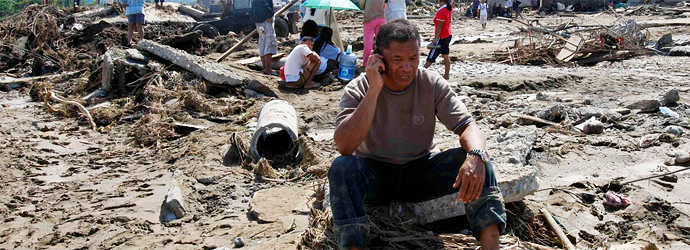
Mobile technology increases accuracy and compresses time. Nowhere is this more effectively employed than before, during, and after a natural disaster. Targeted messages can be sent to specific groups of people warning of impending calamity, for example, and then, after the event, data can be collected in real time allowing humanitarian action to be targeted at specific disaster-affected communities more quickly and more accurately than ever before by knowing who has been affected and where.
| Mobile phones can now help determine with reasonable accuracy how many people are affected (or infected) and where they are. |
In Bangladesh, bulk messages are sent warning of the likely scale, location, and timing of floods, storm-surges, tropical cyclones, and tsunami, together with instructions about where to seek shelter. The latter part of the message is tailored to each locality. Syed Ashraf of the country’s Disaster Management Bureau says that, “being localised, it is also much more accurate and gives advice relevant to the area which makes people trust it more”. Follow-up messages are sent regularly advising on preparedness measures to take.
But it’s not just about verbal or text communications. When delivering humanitarian aid to disaster-stricken areas, there is often a severe lack of basic information on the locations of the people in need of help, including the number of people who have left the disaster area. This seriously hampers efforts to deliver the right amount of supplies to the right places, even when sufficient resources are available. Using data supplied by mobile phone operators, it is now possible to determine with reasonable accuracy how many people are affected and where they are, even in remote areas with limited coverage. This technology was used successfully in the Pakistan floods of 2011.
Mobile phones can also be used to predict how many people have been killed, injured, or trapped in an earthquake. When referenced against previous movement patterns, lack of movement of individual mobile phones within a particular cell zone after an earthquake indicates how many people may have been in a particular building at the time. Absence of use and the rate of signal decay due to flat batteries provides a further indication of how many may be trapped and possibly still alive.
Mobile phone tracking can also be employed to reduce the chance of disease outbreaks. During the response to Haiti’s cholera outbreak in late 2010 and Sierra Leone’s in late 2012, it was possible to know which areas had received people from the affected zone, and therefore which areas were at potentially increased risk of a new outbreak[i]. This, in turn, allowed for health messaging over public broadcast radio services to be targeted at particular areas alerting both the incomers and indigenous populations to the heightened risk and what to do to prevent the outbreak from spreading. There is no technical reason that such messaging could not have been targeted to the individuals concerned, although data protection concerns currently preclude this. Mobile technology has also revolutionised the way communicable diseases are monitored after disasters. Already, mobile phones have detected spreading pneumonias in Sri Lanka, and escalating diarrhoeal diseases in Tamil Nadu within a day of the disaster occurring.
The most basic tool, text messaging, is used to communicate with specific disaster-affected populations. Geo-SMS identifies phones in a specific area and sends out messages from relief agencies asking if help is required to those phones only. A reply triggers a menu of options they can choose from, such as: “Do you need: 1) First Aid, 2) Medications, 3) Transport, 4) Food, 5) Water, 6) Shelter (press the corresponding number)”. This system is also used for sending early warning alerts. In the case of a tsunami, for example, it is pointless and potentially counter-productive to send such messages to mobile phone subscribers living on hillsides above low-lying zones where violent ingress of water could be expected. Yet, at the same time, it is important to alert those who may be involved in the aftermath, such as hospital staff.
Absence of timely and accurate data following a natural disaster is one of the greatest obstacles to overcoming public health challenges as people struggle to survive. Less than a decade ago, a woman in premature labour brought on by the stress of a disaster’s aftermath would have had few options to access life-saving treatment if an emergency health clinic had not been set up nearby. But today, mobile telephone technology can help her obtain medical advice over the phone, alert a community midwife to her plight, or even ask a volunteer to get her to the nearest hospital.
Also, the time taken to record health information can be slow when health workers have only paper and pencil to record where suspected cholera cases live, which children have been vaccinated, or where vital supplies have been sent. Paper is cumbersome; it has to be carried, kept dry, and it has to be photocopied. And then the data has to be re-entered manually on some computer somewhere. All of this is inefficient, and takes time. Software such as EpiSurveyor which was developed by the UN and the Vodafone Technology Partnership as an open-source platform, is typical of the sort of technology that can be used to control supplies and monitor areas where outbreaks are suspected, as it is “much cheaper, faster, of better quality, and easier to do than pencil and paper”.
And finally, there is mobile cash transfer. In October 2011, the UN’s World Food Programme started using mobile telephones to facilitate cash transfers to 54,000 of the most food insecure people living in the Ivory Coast who lost their livelihoods during the political crisis earlier in the year, and who lacked the resources to buy their food in the local markets.
For the potential of mobile telephony to be
unlocked in the ways described here, the service providers have to be involved.
For reasons of data protection, they are unusually discreet in how they apply
the algorithms needed, and with which national and/or international authorities
they coordinate. Care also has to be taken in how apparently valid information
is moderated, as the humanitarian sector is as prone to manipulation and
hacking as anyone else. Dilemmas over the unprecedented level of information
sharing facilitated by this technology have led to debates over how the
humanitarian sector can most effectively harness the full potential of this
technology while retaining a principled approach to disaster preparedness,
response, and recovery.
[i] Bengtsson et al: Improved response to disasters and outbreaks by tracking population movements with mobile phone network data – a post-earthquake geospatial study in Haiti; 2011 (doi:10.1371/journal.pmed. 1001083).